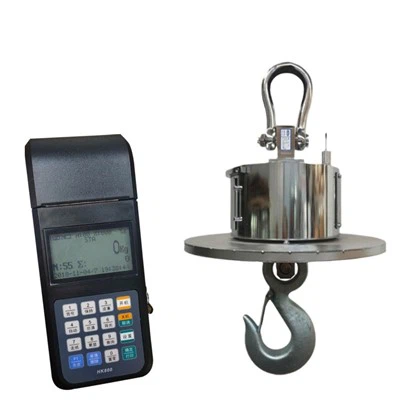
When it comes to weighing heavy loads, crane scales play a crucial role in various industries such as construction, manufacturing, shipping, and logistics. As a crane scale supplier, I have witnessed firsthand the importance of accurate weighing in ensuring safety, efficiency, and compliance with industry regulations. In this blog post, I will delve into the factors that affect the accuracy of crane scales and provide insights on how to choose the right scale for your specific needs.
Understanding the Basics of Crane Scale Accuracy
Accuracy is defined as the degree of closeness between the measured value and the true value of a quantity. In the context of crane scales, accuracy refers to how closely the scale's reading matches the actual weight of the load being weighed. The accuracy of a crane scale is typically expressed as a percentage of the full-scale capacity (FSC) or in units of weight, such as kilograms or pounds.
For example, a crane scale with an accuracy of ±0.1% of FSC means that the scale's reading can deviate by up to 0.1% from the true weight of the load. If the scale has a full-scale capacity of 10,000 kg, the maximum error would be ±10 kg (0.1% of 10,000 kg).
Factors Affecting Crane Scale Accuracy
Several factors can affect the accuracy of crane scales, including:
1. Load Cell Accuracy
The load cell is the heart of a crane scale, responsible for converting the mechanical force exerted by the load into an electrical signal. The accuracy of the load cell directly impacts the overall accuracy of the scale. High-quality load cells are designed to have low non-linearity, hysteresis, and creep, which are common sources of error in weighing systems.
2. Environmental Conditions
Environmental factors such as temperature, humidity, and vibration can also affect the accuracy of crane scales. Extreme temperatures can cause the load cell to expand or contract, leading to changes in its electrical properties and affecting the scale's reading. Humidity can cause corrosion of the scale's components, while vibration can introduce noise into the electrical signal, resulting in inaccurate readings.
3. Installation and Calibration
Proper installation and calibration are essential for ensuring the accuracy of crane scales. The scale should be installed in a stable and level position, away from sources of vibration and electromagnetic interference. Regular calibration is also necessary to maintain the scale's accuracy over time. Calibration involves comparing the scale's readings to a known standard weight and adjusting the scale's settings as needed.
4. Overloading and Shock Loading
Overloading a crane scale beyond its rated capacity can cause permanent damage to the load cell and other components, resulting in inaccurate readings. Shock loading, which occurs when a load is suddenly applied or removed from the scale, can also cause damage and affect the scale's accuracy.
Types of Crane Scales and Their Accuracy
There are several types of crane scales available on the market, each with its own level of accuracy and features. Some of the most common types of crane scales include:
1. Mechanical Crane Scales
Mechanical crane scales use a spring or lever mechanism to measure the weight of the load. These scales are relatively simple and inexpensive, but they are also less accurate than electronic crane scales. Mechanical crane scales typically have an accuracy of ±1% to ±2% of FSC.
2. Digital Crane Scales
Digital crane scales use electronic load cells to measure the weight of the load and display the reading on a digital display. These scales are more accurate than mechanical crane scales, with accuracies ranging from ±0.1% to ±0.5% of FSC. Digital crane scales also offer additional features such as tare function, peak hold, and data logging.
3. Wireless Crane Scales
Wireless crane scales use wireless technology to transmit the weight data from the scale to a remote display or computer. These scales offer the same level of accuracy as digital crane scales, but they provide greater flexibility and convenience in terms of installation and operation. Wireless crane scales are ideal for applications where the scale needs to be located in a hard-to-reach or hazardous area.
Choosing the Right Crane Scale for Your Needs
When choosing a crane scale, it is important to consider the following factors:
1. Capacity
The capacity of the crane scale should be selected based on the maximum weight of the loads that will be weighed. It is recommended to choose a scale with a capacity that is at least 20% higher than the maximum expected load to allow for some margin of safety.
2. Accuracy
The accuracy of the crane scale should be selected based on the specific requirements of your application. If high accuracy is required, such as in a laboratory or quality control environment, a digital crane scale with an accuracy of ±0.1% to ±0.2% of FSC may be necessary. For general industrial applications, a scale with an accuracy of ±0.5% of FSC may be sufficient.
3. Environmental Conditions
The environmental conditions in which the crane scale will be used should also be considered. If the scale will be exposed to extreme temperatures, humidity, or vibration, a scale that is designed to withstand these conditions should be selected. For example, a Stainless Steel Crane Scale is ideal for use in harsh environments where corrosion is a concern.
4. Features
The features of the crane scale should also be considered based on your specific needs. Some of the features that may be useful include tare function, peak hold, data logging, and wireless connectivity.
Ensuring the Accuracy of Your Crane Scale
Once you have selected the right crane scale for your needs, it is important to take steps to ensure its accuracy over time. Some of the best practices for maintaining the accuracy of your crane scale include:
1. Regular Calibration
Regular calibration is essential for maintaining the accuracy of your crane scale. Calibration should be performed at least once a year, or more frequently if the scale is used in a high-precision application or if it is exposed to harsh environmental conditions.


2. Proper Installation and Maintenance
Proper installation and maintenance of your crane scale are also important for ensuring its accuracy. The scale should be installed in a stable and level position, away from sources of vibration and electromagnetic interference. Regular maintenance, such as cleaning and lubrication, should also be performed to keep the scale in good working condition.
3. Operator Training
Operator training is essential for ensuring the accurate and safe use of your crane scale. Operators should be trained on how to properly install, calibrate, and operate the scale, as well as how to recognize and address any potential problems or issues.
Conclusion
In conclusion, the accuracy of crane scales is essential for ensuring safety, efficiency, and compliance with industry regulations. By understanding the factors that affect crane scale accuracy and choosing the right scale for your specific needs, you can ensure that your weighing operations are accurate and reliable. As a crane scale supplier, I am committed to providing high-quality scales that meet the needs of our customers. If you have any questions or need assistance in choosing the right crane scale for your application, please contact us for more information. We look forward to working with you to meet your weighing needs.
References
- ASTM E4-18 Standard Practices for Force Verification of Testing Machines
- ISO 7500-1:2018 Metallic materials -- Verification of static uniaxial testing machines -- Part 1: Tension/compression testing machines -- Verification and calibration of the force-measuring system
- OIML R76-1:2019 Non-automatic weighing instruments -- Part 1: Metrological and technical requirements -- Tests