



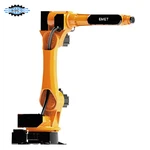

Industrial Robot
Why Choose HEBEI EMET MACHINERY & TECHNOLOGY CO., LTD?
Our company is a mechanical manufacturing enterprise, formerly a lifting machinery manufacturing factory, established in 2005. Located in Qingyuan District, Baoding City, Hebei Province, China, known as the hometown of lifting machines, covering an area of 3200 square meters, with advanced production equipment and a comprehensive quality management system, we are committed to providing customers with high-quality mechanical manufacturing services.
Professional Technical Team
We have a highly skilled team with strong technical strength and over 100 experienced employees. We insist on continuous innovation and have a series of independently developed precision manufacturing technologies and equipment.
Wide Range of Products
Our products cover various mechanical equipment, such as anti fall devices, electronic scales, manipulator arms, etc; At the same time, we can also customize production according to customer needs.
Quality Assurance
We strictly follow the requirements of the ISO9001 quality management system for production, and all products have passed CE certification, with a high market share.At the same time, we also have advanced production lines to provide customers with high-quality mechanical equipment.
Professional Service
We provide excellent after-sales service, track usage, and provide positive feedback. We will respond quickly within 24 hours and provide customers with solutions.


What is Industrial Robot?
An industrial robot is one that has been developed to automate intensive production tasks such as those required by a constantly moving assembly line. As large, heavy robots, they are placed in fixed positions within an industrial plant and all other worker tasks and processes revolve around them.

Features of EMET Industrial Robot
Precision and Accuracy: Industrial robots are engineered for precise and accurate movements, ensuring they can perform tasks with a high degree of accuracy.
Programming Flexibility: These robots can be programmed to execute a wide range of tasks, making them adaptable to different manufacturing processes.
Repeatability: Industrial robots can repeat tasks consistently without a decline in accuracy, contributing to reliable and uniform production processes.
Speed and Efficiency: They are capable of high-speed operations, leading to increased efficiency in manufacturing processes.
Payload Capacity: Industrial robots come with varying payload capacities, allowing them to handle different weights and sizes of materials or products.
Safety Features: Advanced safety features, such as sensors and collision detection systems, ensure a safe working environment by preventing accidents and collisions with humans or other objects.
Versatility in End Effectors: The end effector or tool attached to the robot can be customized for specific tasks, enhancing the robot's ability to handle diverse operations.
Integration with Other Systems: Industrial robots can be integrated with other manufacturing systems, creating a seamless and automated production line.
Remote Monitoring and Control: Some robots offer remote monitoring and control capabilities, allowing operators to manage and monitor the robot's performance from a distance.
Energy Efficiency: Many industrial robots are designed to be energy-efficient, helping to reduce operational costs and environmental impact.
Adaptive Learning: Some advanced industrial robots are equipped with adaptive learning capabilities, enabling them to improve their performance over time through experience and data analysis.
Long Operating Life: Industrial robots are built to withstand harsh industrial environments, ensuring a long operating life with minimal maintenance requirements.
Modularity: Modular designs enable easy upgrades and modifications, allowing businesses to adapt the robot to changing production needs.
Integration with Industry 4.0 Technologies: Industrial robots often integrate with Industry 4.0 technologies, such as IoT (Internet of Things) connectivity and data analytics, enhancing overall manufacturing efficiency and control.

Collaborative Robots
Collaborative Robots or Cobots are robots that can directly and safely interact with humans in a shared workspace. There are numerous types and brands of collaborative robots on the market.
Cartesian Robots
Cartesian robots, which are also called linear robots or gantry robots, are industrial robots that work on three linear axes that use the Cartesian Coordinate system (X, Y, and Z), meaning they move in straight lines on 3-axis (up and down, in and out, and side to side). Cartesian robots are a popular choice due to being highly flexible in their configurations, giving users the ability to adjust the robot’s speed, precision, stroke length, and size. Cartesian Robots are one of the most commonly used robot types for industrial applications and are often used for CNC machines and 3D printing.
SCARA Robots
SCARA is an acronym that stands for Selective Compliance Assembly Robot Arm or Selective Compliance Articulated Robot Arm. SCARA Robots function on 3-axis (X, Y, and Z), and have a rotary motion as well. SCARA Robots excel in lateral movements and are commonly faster moving and have easier integration than Cartesian Robots. Typically, SCARA robots are used for assembly and palletizing, as well as bio-med application.
Articulated Robots
Articulated Robots mechanical movement and configuration closely resembles a human arm. The arm is mounted to a base with a twisting joint. The arm itself can feature anywhere from two rotary joints up to ten rotary joints which act as axes, with each additional joint or axis allowing for a greater degree of motion. Most Articulated Robots utilize four or six-axis. Typical applications for Articulated Robots are assembly, arc welding, material handling, machine tending, and packaging.
Cylindrical Robots
Cylindrical Robots have a rotary joint at the base and a prismatic joint to connect the links. The robots have a cylindrical-shaped work envelop, which is achieved with rotating shaft and an extendable arm that moves in a vertical and sliding motion. Cylindrical Robots are often used in tight workspaces for simple assembly, machine tending, or coating applications due to their compact design.
Delta Robots
Delta Robots, or parallel robots, possess three arms connected to a single base, which is mounted above the workspace. Delta Robots work in a dome-shape and can move both delicately and precisely at high speeds due to each joint of the end effector being directly controlled by all three arms. Delta Robots are often used for fast pick and place applications in the food, pharmaceutical, and electronic industries.
Polar Robots
Polar Robots, or spherical robots, have an arm with two rotary joints and one linear joint connected to a base with a twisting joint. The axes of the robot work together to form a polar coordinate, which allows the robot to have a spherical work envelope. Polar Robots are credited as one of the first types of industrial robots to ever be developed. Polar robots are commonly used for die casting, injection molding, welding, and material handling.
Advantages of Industrial Robot
Better Quality and Consistency
Along with other tech — such as the industrial internet of things (IIoT) or 3D printing robots — industrial robots are able to provide better production quality and more precise and reliable processes. Added benefits also include reduced cycle times and real-time monitoring to improve preventive maintenance practices.
Maximum Productivity and Throughput
An industrial robot increases speed for manufacturing processes, in part by operating 24/7. Robots don’t need breaks or shift changes. The speed and dependability of robots ultimately reduces cycle time and maximizes throughput.

Greater Safety
Using robots for repetitive tasks means fewer risks of injury for workers, especially when manufacturing has to take place under hostile conditions. In addition, supervisors can oversee the process online or from a remote location.
Reduced Direct Labor Costs
The cost of having a person handle many manufacturing operations is often more expensive than robot. This can also free up workers so their skills and expertise can be used in other business areas, such as engineering, programming and maintenance.
Application of Industrial Robot
Arc Welding
Arc welding, or robot welding, became commonplace in the 1980s. One of the driving forces for switching to robot welding is improving the safety of workers from arc burn and inhaling hazardous fumes.
Spot Welding
Spot welding joins two contacting metal surfaces by directing a large current through the spot, which melts the metal and forms the weld delivered to the spot in a very short time (approximately ten milliseconds).
Materials Handling
Material handling robots are utilized to move, pack and select products. They also can automate functions involved in the transferring of parts from one piece of equipment to another. Direct labor costs are reduced and much of the tedious and hazardous activities traditionally performed by human labor are eliminated.
Machine Tending
Robotic automation for machine tending is the process of loading and unloading raw materials into machinery for processing and overseeing the machine while it does a job.
Painting
Robotic painting is used in automotive production and many other industries as it increases the quality and consistency of the product. Cost savings are also realized through less rework.
Picking, Packing and Palletizing
Most products are handled multiple times prior to final shipping. Robotic picking and packaging increases speed and accuracy along with lowering production costs.
Assembly
Robots routinely assemble products, eliminating tedious and tiresome tasks. Robots increase output and reduce operational costs.
Mechanical Cutting, Grinding, Deburring and Polishing
Building dexterity into robots provides a manufacturing option that is otherwise very difficult to automate. An example of this is the production of orthopedic implants, such as knee and hip joints. Buffing and polishing a hip joint by hand can normally take 45-90 minutes while a robot can perform the same function in just a few minutes.
Gluing, Adhesive Sealing and Spraying Materials
Sealer robots are built with numerous robotic arm configurations that enable the robot to apply adhesives to any type of product. The primary benefit in this application is increased quality, speed and consistency of the final product.
Other Processes
These include inspection, waterjet cutting and soldering robots.
How to Choose Industrial Robot
Flexibility
If your application requires five or six degrees of freedom, you’ll likely need an articulated robot. If you only need one or two axes, you can choose a less expensive model.
Speed
If your operation needs a very high production speed, a delta robot would be recommended.
Space and Footprint
A cartesian or delta robot will offer the advantage of a smaller footprint that will take up less factory floor space.
Engineering
Consider the cost of design, assembly, and installation.
Reliability
A mechanical failure can result in costly production delays. If your robots are easy to troubleshoot and repair, you can ramp production back up with minimal delays.
Maintenance of Industrial Robot
Daily Checks
Some essential functions should occur on a daily basis to ensure industrial robots are functioning to standards. These checks are cursory but will catch the majority of glaring problems with industrial robots before they begin their daily operations. These checks are as follows:
Visually check external components for damage and wear.
Remove any dust or debris from sensors or optical components.
Check for grease or oil leaks and clean and refill when necessary.
Listen for any excessive vibration or unusual noises.
Monthly Checks
Monthly checks should be more detailed than daily checks but are still largely superficial. These will catch any operational issues and prevent the majority of problems that occur:
Clean and ventilate the robot controller’s cooling fans to maximize airflow.
Back up the robot controller’s memory.
Complete a visual inspection of the robot in motion, checking the robot, harness and cables.
Quarterly Checks
Quarterly checks are even more detailed than monthly checks and focus on safety features and fixtures. These checks include the following:
Check all connections between the robot and any power supplies, fans or safety equipment.
Check all unit cables for any kinks, pinch points, cuts, tears or loose connections.
Tighten all bolts, especially external mounting bolts.
Detail clean the mechanical unit to remove any chips or debris.
Annual Checks
Annual checks should be extremely detailed to cover all aspects of machine functionality. This is the time to review any performance metrics from the last year to see if the machine has shown any signs of slowing down or consuming more power than usual. Some of the checks include the following:
It is recommended to replace batteries every year in the mechanical unit, RAM, APC and CPU. It is essential to ensure these batteries do not die, since this may cause serious issues in functionality.
Replace grease and oil and be sure to select options that are recommended by the manufacturer.
Inspect the operation of the brake to ensure no delays.
Complete thorough functional tests to make sure the robot meets specifications.
Components of Industrial Robot
The controller is essentially the robot's brain. It's a specialized computer that communicates with the robot and tells it what to do. This is the link between the human operator and the robot. The controller comprises both hardware and software components to handle varying tasks, from motion control to data processing.
The robotic arm is a key part of any Industrial robot system. The robot arm mimics the movements of a human arm and consists of three main parts: the base, shoulder, and forearm. These parts feature joints and electric motors to control their movement, providing flexibility and precision.
Each joint provides the Industrial robot with a specific degree of freedom. For example, the shoulder moves up and down, the elbow forward and backwards, and the wrist allows the end effector (essentially the robot's hand) to grab and manipulate objects.
Also known as end-of-arm tools, end-effectors are the hands of robots. End-effectors come in various types, depending on the application. Some robots have multiple end-effectors that can be swapped as needed depending on the task at hand. Two common end-effectors are grippers and tooling.
Manufacturers often create custom end-effectors to meet specific needs. For example, in the automotive industry, robots use end-effectors designed to handle parts like doors, seats, or engines during assembly.
The sensors are basically the robot's senses, and they play an important role in how these robots operate. They provide vital information about the robot's surroundings, allowing it to make real-time decisions. The most common types are vision systems and microphones, which act as the robot's eyes and ears.
The drive system is what powers the robot's movements. It provides the force and motion needed to move the robot's parts. There are three main types of drive systems: hydraulic, electric, and pneumatic. The choice between these drive systems depends on the specific needs of the robot and the tasks it's designed for.
Our Factory
We have a complete factory production, quality supervision and delivery.

Ultimate FAQ Guide to Industrial Robot
Q: What is an industrial robot?
Q: What are industrial robots used for?
Q: What are the different types of industrial robots?
Q: What is an articulated robot?
Q: What is a SCARA robot?
Q: What are the safety considerations when working with industrial robots?
Q: What is the future of industrial robotics?
Q: What is the cost of an industrial robot?
Q: What are the benefits of using industrial robots?
Q: What are the disadvantages of using industrial robots?
Q: How do industrial robots work?
Q: What is the difference between programming and teaching an industrial robot?
Q: What type of programming language is used for industrial robots?
Q: What skills are needed to work with industrial robots?
Q: What is the role of sensors in industrial robots?
Q: What is the role of end-effectors in industrial robots?
Q: What is a collaborative robot?
Q: What is the difference between a traditional industrial robot and a collaborative robot?
Q: What are the benefits of using collaborative robots?
Q: What are some examples of tasks suited for collaborative robots?