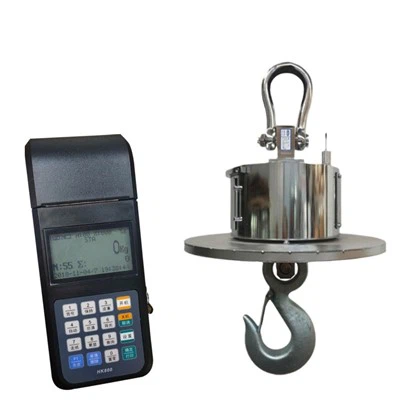
When it comes to industrial weighing applications, steel crane scales play a crucial role in ensuring accurate measurements. As a supplier of steel crane scales, I have witnessed firsthand the importance of precision in these devices. In this blog post, I will delve into the accuracy of steel crane scales, exploring the factors that affect it and how we ensure high - precision performance in our products.
Understanding the Basics of Steel Crane Scales
Steel crane scales are designed to be suspended from a crane or hoist and are used to weigh heavy loads. They are commonly found in industries such as construction, manufacturing, shipping, and logistics. The basic principle behind a steel crane scale is the use of load cells. These load cells are sensors that convert the force exerted by the load into an electrical signal. This signal is then processed and displayed as a weight reading on the scale's digital display.
Factors Affecting the Accuracy of Steel Crane Scales
- Load Cell Quality
The load cell is the heart of a steel crane scale. High - quality load cells are made from materials such as stainless steel or alloy steel, which are known for their durability and resistance to corrosion. The accuracy of a load cell is typically measured in terms of its non - linearity, hysteresis, and creep. Non - linearity refers to the deviation of the load cell's output from a straight - line relationship between the applied load and the output signal. Hysteresis is the difference in the output signal when the load is increasing and decreasing. Creep is the slow change in the output signal over time under a constant load. At our company, we source load cells from reputable manufacturers that adhere to strict quality control standards to ensure minimal non - linearity, hysteresis, and creep. - Environmental Conditions
Environmental factors can have a significant impact on the accuracy of steel crane scales. Temperature, humidity, and vibration can all affect the performance of the load cells. For example, extreme temperatures can cause the load cell to expand or contract, leading to inaccurate readings. High humidity can also cause corrosion of the load cell, which can degrade its performance over time. Vibration from the crane or other machinery can introduce noise into the electrical signal, resulting in inaccurate weight measurements. To mitigate these effects, our steel crane scales are designed with environmental protection features. They are often housed in rugged enclosures that protect the load cells from dust, moisture, and vibration. Additionally, our scales are calibrated to account for temperature variations within a certain range. - Calibration
Calibration is a critical process for ensuring the accuracy of steel crane scales. A properly calibrated scale will provide accurate weight measurements within a specified tolerance. Calibration involves comparing the scale's readings against a known standard weight. This process should be carried out regularly, especially after the scale has been subjected to heavy use, transportation, or any significant impact. At our company, we provide calibration services for our steel crane scales. Our technicians use high - precision calibration weights to ensure that the scales are accurate to within a very tight tolerance. We also offer calibration certificates to our customers, which provide documentation of the scale's accuracy.
Assessing the Accuracy of Our Steel Crane Scales
We take several steps to ensure the high accuracy of our steel crane scales. Firstly, we conduct rigorous testing during the manufacturing process. Each scale is tested under various load conditions to ensure that it meets our quality standards. We also perform calibration checks at multiple points along the scale's range to verify its accuracy.
Secondly, we use advanced technology in our steel crane scales. Our scales are equipped with high - resolution analog - to - digital converters (ADCs) that can accurately convert the analog signals from the load cells into digital values. This allows for precise weight measurements, even for small changes in the load.
In addition, we offer a range of features that enhance the accuracy of our scales. For example, some of our scales have built - in filtering algorithms that can reduce the effects of vibration and noise. Others have auto - zero functions that automatically adjust the scale's reading to zero when there is no load, eliminating any offset errors.


Our Product Range and Their Accuracy
We offer a diverse range of steel crane scales to meet the different needs of our customers.
- Digital Crane Scale 3 Ton: This scale is designed for heavy - duty applications and can accurately measure loads up to 3 tons. With its high - precision load cells and advanced electronics, it provides reliable and accurate weight measurements. You can learn more about this product Digital Crane Scale 3 Ton.
- Hanging Weighing Scale 1000kg: Ideal for medium - sized loads, this scale offers excellent accuracy for weighing loads up to 1000 kg. It is easy to use and can be quickly installed on a crane or hoist. For more details, visit Hanging Weighing Scale 1000kg.
- Precision Crane Scale: Our precision crane scale is designed for applications where the highest level of accuracy is required. It uses state - of - the - art load cell technology and advanced signal processing algorithms to provide extremely accurate weight measurements. Check out this product at Precision Crane Scale.
Importance of Accurate Steel Crane Scales
Accurate steel crane scales are essential for several reasons. In industries such as manufacturing, accurate weighing is crucial for quality control. Incorrect weight measurements can lead to product defects, which can result in costly rework or customer dissatisfaction. In the shipping and logistics industry, accurate weighing is necessary for calculating shipping costs and ensuring compliance with weight regulations.
In construction, accurate weighing of materials such as steel beams and concrete blocks is important for ensuring the structural integrity of buildings and other structures. Overall, accurate steel crane scales help to improve efficiency, reduce waste, and enhance safety in industrial operations.
Contact Us for Your Weighing Needs
If you are in the market for high - accuracy steel crane scales, we are here to help. Our team of experts can assist you in selecting the right scale for your specific application. We offer competitive pricing, excellent customer service, and reliable after - sales support. Whether you need a small - capacity scale for light - duty applications or a large - capacity scale for heavy - duty industrial use, we have the solution for you. Contact us today to discuss your requirements and start a procurement negotiation.
References
- ISO 376:2011, Metallic materials - Calibration of force - proving instruments used for the verification of uniaxial testing machines.
- ASTM E4 - 16, Standard Practice for Calibration of Force Measuring Instruments for Verifying the Force Indicating Capacity of Testing Machines.