

Regarding the selection between "Electric Chain Hoist VS Steel Wire Rope Hoist", the conclusion is very clear:
- If your workstation space is limited, you pursue high-precision positioning, and the lifting weight is below 5 tons, the preferred choice is the electric chain hoist;
- If your lifting requirements exceed 5 tons and you are seeking rapid lifting and lowering speeds as well as high-frequency heavy-load operations, wire rope electric hoists offer more advantages.
According to the standards of GB/T 3811-2008 "Crane Design Code" and JB/T 5317-2016 "Electric Chain Hoist", the selection of equipment must strictly match the working level (M3-M6) and rated lifting capacity. EMET reminds you: Choosing the wrong type will not only reduce production efficiency, but may also pose core safety hazards due to long-term overload or improper wear.
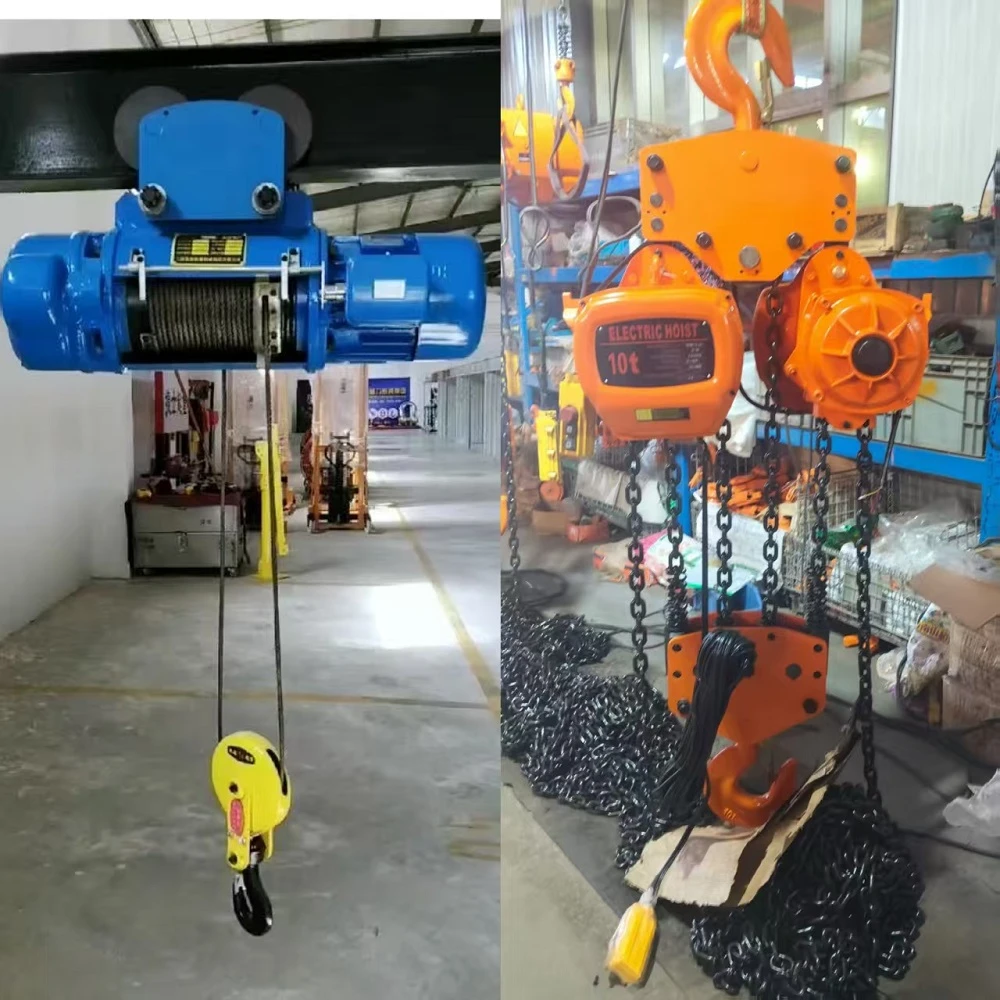
What is the essential difference between a chain hoist and a wire rope hoist?
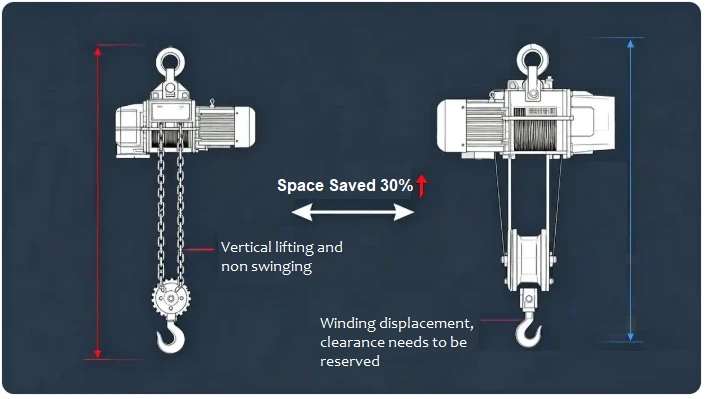
The electric chain hoist utilizes a chain as the load-bearing component and is driven by a chain wheel, featuring a compact structure. On the other hand, the wire rope electric hoist employs a wire rope as the load-bearing component and utilizes a drum for hoisting, exhibiting a more traditional structure.
Core differences: The chain hoist is suitable for frequent starts and stops, as well as low-speed precise positioning; the wire rope hoist is suitable for large lifting capacities and higher lifting speeds.
How to match the lifting capacity with the working level?
According to Article 4.2.3 of GB/T 3811-2008, the working levels of electric hoists are divided into M3-M6, with different lifting capacities corresponding to different applicability.
|
Lifting capacity range |
Electric chain hoist |
Wire rope electric hoist |
Recommended job level |
|
0.5-2 tons |
Very applicable, with precise positioning |
Applicable but bulky |
M3-M4 |
|
2-5 tons |
Applicable, with high cost-effectiveness |
Applicable, mature, and reliable |
M4-M5 |
|
5-10 tons |
▲! "Less used, the chain is relatively thick." |
Mainstream choice |
M5-M6 |
|
Over 10 tons |
× Not recommended |
The only choice |
M6 |
Table-1. Comparison Table of Applicable Lifting Capacity Between Chain Hoist and Wire Rope Hoist
Selection advice: For loads below 5 tons and frequent inching positioning, choose a chain sling; for loads above 5 tons and large lifting heights, choose a wire rope.
What is the difference between maintenance cost and service Life?
|
Comparat ive Dimension |
Electric Chain Hoist |
Wire Rope Electric Hoist |
|
Vulnerable parts |
Chain (replaceable link after wear) |
Wire rope (needs to be replaced as a whole) |
|
Lubrication requiremen ts |
Regularly oil the chain |
Regularly lubricate the steel wire rope and inspect for broken wires |
|
Service life |
The lifespan of the chain is approximately 3-5 years (based on M4 working grade) |
The lifespan of steel wire rope is approximately 1-3 years (depending on the frequency of use) |
|
Replacement cost |
The cost of replacing the chain is relatively low |
The steel wire rope needs frequent replacement, resulting in high cumulative costs |
|
Routine Inspection |
Check the elongation and wear of the chain links |
Check for broken wires and rust |
Table-2. Comparison of Maintenance Cost and Lifespan
Data source: Taking the work-level M4 and daily operation of 4 hours as an example, the replacement cycle of the endless chain is about 3 years,with a cost of about RMB1800-2500; the replacement cycle of the steel wire rope is about 1.5 years, with a single cost of about RMB800-1200 ,but the cumulative replacement frequency is high. The cost data in this article is based on the statistics of EMET's service cases in the Yangtze River Delta, Guangdong, Beijing, Tianjin, and other regions from 2023 to 2026, for reference only.
How to choose installation space and applicable scenarios?
|
Low clearance (<3m) |
The chain has a small bending radius, making it more adaptable |
Requires a larger reel space |
|
Narrow workstation |
Compact structure, small spacing between hooks |
Reel occupies a large width |
|
Open air/dusty environment |
The chain is prone to rust, thus protection is required |
Steel wire rope has stronger adaptability |
|
clean room |
The chain has few chips, and stainless steel chain is optional |
Wire rope grease contamination |
Table-3. Comparison of Space Cleanliness Application
Selection recommendation: For low clearance, narrow workstations, and clean workshops, priority should be given to chain hoists; for outdoor, dusty, and highly corrosive environments, priority should be given to steel wire rope hoists.
How to balance investment costs and long-term benefits?
|
Comparative Dimension |
Electric Chain Hoist |
Wire Rope Electric Hoist |
|
Initial procurement cost |
About 10%-20% higher under the same specification |
Lower |
|
Installation cost |
Simple, small in size |
The reel requires more space |
|
Energy consumption |
Slightly higher efficiency (chain wheel drive) |
The efficiency is slightly low |
|
Long-term maintenance cost |
The chain replacement cycle is long, resulting in a low total cost |
The frequent replacement of steel wire ropes results in high total costs |
|
Residual value |
The chain is recyclable |
The residual value of steel wire rope is low |
Table-4. Comparison Table of Cost and Benefits
Selection advice: For short-term use or tight budgets, choose steel wire rope hoists; for long-term use and frequent operations, it is more cost-effective to choose chain hoists.
Quick reference table for scene adaptation
|
Typical Scenario |
Recommended Type |
Recommended Configuration |
Reason |
|
Frequent lifting operations on the workshop assembly line |
Chain hoist |
Lifting capacity of 1-3 tons, dual-speed, M5 working class |
Frequent start-stop, precise positioning |
|
Warehouse heavy material loading and unloading |
Wire rope hoist |
Lifting capacity of 5-10 tons, single speed, M4 |
Large lifting capacity, intermittent operation |
|
Mold replacement/machinetool loading and unloading |
Chain hoist |
Lifting capacity of 2-5 tons,with limit switch |
Precise positioning,low clearance |
|
Outdoor yard/wharf |
Wire rope hoist |
Lifting capacity of over 10 tons, corrosion-resistant |
Poor environment, large tonnage |
|
Clean workshop (electronics/pharmaceutical) |
Chain hoist |
Stainless steel chain, anti-static |
Dust-free and oil-free pollution |
|
Maintenance station/occasionally used |
Wire rope hoist |
Lifting capacity of 1-3 tons, economical model |
Low usage frequency, cost priority |
Table-5. Quick Reference Table for Electric Hoist Adaptation in Six Scenarios


