

In industrial production, logistics handling, and some scenarios that require repetitive labor, Pneumatic Manipulator Arms are playing an increasingly important role. It can effectively reduce the labor intensity of operators, improve work efficiency, and reduce operational risks. Faced with a wide variety of pneumatic manipulator arms in the market, how to choose a device that suits their own needs has become a concern for many users. EMET will provide you with some reference information from the aspects of type, characteristics, application scenarios, and purchasing points.
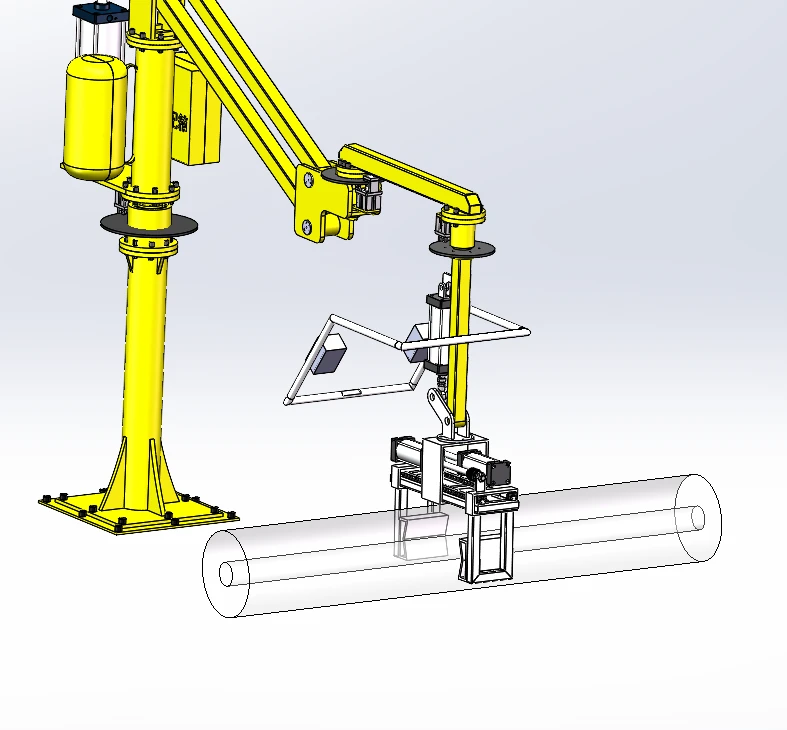
Clearly define load requirements
This is the most fundamental purchasing factor. It is necessary to accurately evaluate the conventional weight, innovative weight, and center of gravity position of the materials to be transported. The selected assistive robotic arm has a diversified rated load greater than or equal to the innovative working load, and leaves a certain safety margin. Do not overload for use.
Evaluate workflow and environment
Carefully analyze the entire process of material handling, including the height difference of the picking and placing points, the distance and range of the moving path, the requirements for positioning accuracy, and the work pace.
- If the workspace is spacious, the movement path is not fixed, and the accuracy requirements are average, the soft cable type may be more flexible.
- If precise assembly and positioning are required within the workstation, the movement trajectory is relatively fixed, and a hard arm type is more suitable.
Environmental factors are also crucial, such as whether the workshop has a stable gas source (determining the feasibility of pneumatic), whether there are explosion-proof requirements, and whether the space is narrow.
Consider the adaptability of the fixture
The pneumatic manipulator arm itself is just an "arm", and the final gripper that completes the grasping action is the end effector. The diversification of fixtures is well matched with the shape, size, material, and special requirements of the workpiece to be transported (such as fear of scratching and need to maintain balance). Common clamps include mechanical fixtures, vacuum suction cups, magnetic suction cups, etc. Ensure that the selected equipment can be easily installed and adapted to the fixtures you need.
Pay attention to security performance
Safety is of paramount importance. The equipment should have necessary safety protection devices, such as mechanical self-locking devices to prevent accidental falls of loads, overload protection, gas source pressure loss protection, emergency stop buttons, etc. The structure of the equipment should be sturdy and reliable, in compliance with relevant safety standards and regulations.
Budget and maintenance costs
There are significant differences in initial investment costs and subsequent maintenance costs among different types of pneumatic manipulator arms. It is necessary to choose a cost-effective solution within the budget range. At the same time, consideration should be given to the future maintenance convenience of the equipment, the availability of spare parts, and the technical support capabilities of the supplier.
As an important labor-saving tool, the selection of pneumatic manipulator arms is a comprehensive decision-making process. There is no one type that is suitable for all scenarios. The key is to deeply analyze one's specific needs, including load, accuracy, process, environment, and budget, in order to find the most suitable one among different types such as hard arm and soft cable.


