



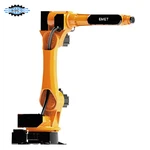

Material Handling Robots
Why Choose HEBEI EMET MACHINERY & TECHNOLOGY CO., LTD?
Our company is a mechanical manufacturing enterprise, formerly a lifting machinery manufacturing factory, established in 2005. Located in Qingyuan District, Baoding City, Hebei Province, China, known as the hometown of lifting machines, covering an area of 3200 square meters, with advanced production equipment and a comprehensive quality management system, we are committed to providing customers with high-quality mechanical manufacturing services.
Professional Technical Team
We have a highly skilled team with strong technical strength and over 100 experienced employees. We insist on continuous innovation and have a series of independently developed precision manufacturing technologies and equipment.
Wide Range of Products
Our products cover various mechanical equipment, such as anti fall devices, electronic scales, manipulator arms, etc; At the same time, we can also customize production according to customer needs.
Quality Assurance
We strictly follow the requirements of the ISO9001 quality management system for production, and all products have passed CE certification, with a high market share.At the same time, we also have advanced production lines to provide customers with high-quality mechanical equipment.
Professional Service
We provide excellent after-sales service, track usage, and provide positive feedback. We will respond quickly within 24 hours and provide customers with solutions.


Material handling robots are automated machines that are designed to move, store, and transport materials or products from one location to another. These robots are commonly used in manufacturing, warehousing, and logistics industries to handle various materials, such as raw materials, finished goods, and packaging materials. These robots can perform a wide range of tasks, including picking, packing, palletizing, sorting, and transporting materials, which can help businesses improve their productivity, efficiency, and safety. Material handling robots can be controlled using a variety of technologies, such as programmable logic controllers, sensors, and machine vision systems, and can be integrated into existing production systems to automate material handling tasks.

Features of Material Handling Robots
Versatility
Material handling robots are versatile and can perform a variety of tasks like lifting, moving, sorting, and stacking.
High Payload Capacity
These robots can handle heavy loads, in the range of hundreds to thousands of kilograms depending on the model and application.
Precision
Material handling robots are precise in their movements and can handle delicate objects without causing damage.
Speed
They can move at high speeds, which is important for applications that require fast and frequent movement of materials.
Flexibility
These robots are flexible and can be programmed to handle different types of materials, shapes, weights, and sizes.
Safety
Material handling robots are designed with safety features such as sensors and emergency stop buttons, which make them safe to use.
Low Maintenance
These robots require minimal maintenance, reducing downtime and overall costs.
Remote Access
Some models can be controlled remotely, which allows for greater flexibility and convenience.
Cost-Effective
Over time, material handling robots can reduce labor costs while increasing efficiency and productivity.
Integration
They can be easily integrated with other machines, equipment, and systems in a production line, making them an integral part of many manufacturing processes.

Types of Material Handling Robots
Packing Products
A common material handling task is packing products for shipment or further processing. The task doesn’t add any value to the product itself. It is a classic “in-between” step.
Robots are perfect for packing. They are flexible enough that you can seamlessly handle various types of products with the same robot.
Part Transfer
Many steps in a manufacturing process simply involve moving parts from one area in the facility to another. This is a boring task and is not a good use of people’s time.
Robotic part transfer is an easy application to deploy and program, which makes this a very good first robotic task.
Loading and Unloading Conveyors
Conveyors are a common method for moving material around a facility. But, the problem with them is that you need to load and unload the products onto them.
There are three main approaches to loading conveyors:
Get humans to do it, which has all the same challenges listed above.
Deploy complex, bespoke automation solutions to channel items to the next automated step in the process.
Use a robot.
Using a robot has similar flexibility benefits to using people and is much cheaper than complete automation.
Holding Material in Place
Sometimes you simply require parts to be held in place while operations are carried out on them. The traditional approaches to this are to use a human or to create custom fixturing to keep the material steady.
Robots can be easily programmed to handle multiple types of parts. They are often used for this type of task, for example, for holding parts in front of a painting machine.
Palletizing and Depalletizing
Materials likely arrive in your facility packed onto pallets. This requires them to be depalletized, a boring and “back-breaking” job. Similarly, the last stage before products are sent out to customers is usually to load them onto pallets.
Robots are more than just suitable for palletizing tasks, they are often significantly better than humans are at this task. They can pack items with more consistency and will never suffer from the musculoskeletal problems that people do.
Advantages of Material Handling Robots
The Tireless Workforce
Precision and Accuracy
Equipped with sensors and guided by advanced algorithms, material handling robots can carry out tasks with precision and accuracy, significantly minimising the risk of errors. This translates to cost savings and improves customer satisfaction through better quality control and delivery times.
Scalability and Flexibility
Sustainability and Cost Efficiency
Data-Driven Decision Making
The Human-Robot Symbiosis
Application of Material Handling Robots
Goods-To-Person
This is the term used to describe the tasks of bringing parts or other units of material from a warehouse to the operator in an automated manner. Goods-to-person picking reduces unnecessary operator movements and avoids unproductive times.
Intralogistics
In production lines, it is common to find missing components required for manufacturing. A handling robot is able to supply each stage of the production line so that operators can continue with the process.
Handling of Hazardous Material
The precision and advanced technology of a Mobile Handler robot makes it capable of handling toxic, polluting or noxious material that poses a danger to humans.
Palletising
Loading materials onto a pallet is a mechanical task that requires precision and consistency. It is one of the most automated applications in logistics environments because the repeatability rate of a robot handler significantly exceeds that of a human operator. In the case of mobile handlers, the robot can carry out the palletising task at one point in the warehouse and when it is finished, it can move to the location of the next pallet to be loaded or stop, if it has completed its mission. Thus, it is not necessary to bring the pallets to the robotic arm, but the process is reversed: the robot goes autonomously to the pallet.
Sorting
The development of advanced software is key for the manipulator robot to carry out a sorting application accurately and with no margin for error. In fact, it is one of the slowest tasks to be automated due to its complexity. Now, the level of technological development has reached a point that enables and guarantees efficiency. A mobile handling robot can classify different elements following a specific order or pattern, by means of Artificial Intelligence algorithms and other identification, vision and sensorisation systems.
How to Choose Material Handling Robots
Consider the Payload and Range of Industrial Robots
The payload and reach of industrial robots are essential factors to consider when choosing the right robot for your business. The payload refers to the maximum weight that the robot can lift or manipulate, while the reach refers to the maximum distance that the robot can extend.
It's essential to choose an industrial robot with the appropriate payload and reach for your specific applications. If you need a robot to handle heavy loads, you will want to choose a robot with a higher payload capacity. Similarly, if you need a robot to work in a confined space, you will want to choose a robot with a smaller reach.
Consider the Accuracy and Repeatability of Industrial Robots
The accuracy and repeatability of an industrial robots for sale are essential factors to consider when selecting the right robot for your business. The accuracy refers to how closely the robot can position and move its end effector, while the repeatability refers to how consistently the robot can perform the same motion.
It's essential to choose an industrial robot with high accuracy and repeatability for your specific applications. For instance, if you need a robot for precision assembly, you will want to choose industrial robots with high accuracy and repeatability to ensure that the parts are assembled correctly every time.
Consider the Speed and Cycle Time of Industrial Robots
The speed and cycle time of manufacturing robots for sale are other critical factors to consider when selecting the right robot for your business. The speed refers to how quickly the robot can move and perform its tasks, while the cycle time refers to the time it takes for the robot to complete a specific task.
It's essential to choose an industrial robot with the appropriate speed and cycle time for your specific applications. For instance, if you need a robot for high-speed pick-and-place applications, you will want to choose a robot with a fast cycle time to ensure that it can keep up with the production line.
Maintenance of Material Handling Robots
Cleaning
Regularly cleaning the robot and its components helps to remove any dirt, dust, or debris that may accumulate over time. This includes cleaning the robot's exterior, as well as its end-of-arm tooling, sensors, and other components.
Lubrication
Proper lubrication of the robot's moving parts is crucial to ensure smooth operation. This includes lubricating joints, linear guides, ballscrews, and other areas where friction may occur. Be sure to use the appropriate lubricant for each component.
Inspection
Regularly inspecting your robot for any signs of wear, damage, or loose connections is important. This includes inspecting the arms, joints, belts, wiring, and any other components that may be susceptible to wear and tear.
Calibration
If your robot relies on sensors for accurate operation, regular calibration is necessary to ensure precise readings. This includes calibrating any vision systems, force sensors, or other sensing devices that your robot may have.
Software Updates
Keeping your robot's control system up to date is crucial for optimal performance. Regularly check for software updates from the manufacturer and implement them as needed.
Component Maintenance and Replacement
If any components are damaged or worn out, it's important to promptly repair or replace them. This includes belts, sensors, motors, and other critical components.
Principle of Material Handling Robots


Planning Principle
Be clear objectives objectives and functional specifications of the proposed methods.
Standardization Principle
Equipment, controls and software must be standardized within the limits that achieve global performance objectives without sacrificing flexibility, modularity and production.
Work Principle
Material handling work should be minimized without sacrificing productivity or the required level of operation.
Ergonomic Principle
Human capabilities and limitations must be recognized to ensure safe and effective operations.
Unit Load Principle
The unit loads must be of the appropriate size and be configured according to which they achieve a material flow and the inventory objectives at each stage of the supply chain.
Space Utilization Principle
Effective and efficient use of available space must be made.
System Principle
Material movement and storage activities must be fully integrated to form an operating system that encompasses reception, inspection, storage, production, assembly, packaging, unification, order selection, shipping, transportation, and claims handling.
Automation Principle
Material handling operations should be automated where possible in order to improve operational efficiency, increase responses, improve consistency and predictability, and lower operating costs.
If we pay attention to how the industry has changed in the last 20 years, the number of people involved in each of the stages of the process is less and less with new technologies, if it is automated, it gains in reliability, efficiency, safety , time, standardization and transportation, since there is better coordination.
Currently, among the main technologies and solutions that are being used to improve the end of line process, stand out robotized arms systems, automatic palletizing, AGV’s among others.
Environmental Principle
The environmental impact and energy consumption must be considered criteria when selecting equipment for handling materials.
Life Cycle Cost Principle
Develop a comprehensive economic analysis that takes into account the entire life cycle of material handling systems.
If you want to improve your process of material handling online and end of line, contact us, we are ready to support you.
Our Factory
We have a complete factory production, quality supervision and delivery.

Ultimate FAQ Guide to Material Handling Robots
Q: What are material handling robots?
Q: How do material handling robots work?
Q: What are the benefits of using material handling robots?
Q: What types of material handling robots are available?
Q: What industries use material handling robots?
Q: How do you program a material handling robot?
Q: How fast can material handling robots operate?
Q: Do material handling robots require maintenance?
Q: What safety features do material handling robots have?
Q: What is the average cost of a material handling robot?
Q: Can material handling robots handle fragile or sensitive objects?
Q: How do material handling robots navigate around a production environment?
Q: What is the difference between collaborative and non-collaborative material handling robots?
Q: Are material handling robots customizable?
Q: Can material handling robots be integrated with other production systems?
Q: What is the maximum payload capacity of a material handling robot?
Q: What is the lifespan of a material handling robot?
Q: Can material handling robots be moved between different production lines?
Q: How do material handling robots communicate with other machines in a production environment?
Q: Can material handling robots be programmed to work with different materials?