



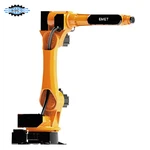


6 Axis Industrial Robot Arm
Why Choose HEBEI EMET MACHINERY & TECHNOLOGY CO., LTD?
Our company is a mechanical manufacturing enterprise, formerly a lifting machinery manufacturing factory, established in 2005. Located in Qingyuan District, Baoding City, Hebei Province, China, known as the hometown of lifting machines, covering an area of 3200 square meters, with advanced production equipment and a comprehensive quality management system, we are committed to providing customers with high-quality mechanical manufacturing services.
Professional Technical Team
We have a highly skilled team with strong technical strength and over 100 experienced employees. We insist on continuous innovation and have a series of independently developed precision manufacturing technologies and equipment.
Wide Range of Products
Our products cover various mechanical equipment, such as anti fall devices, electronic scales, manipulator arms, etc; At the same time, we can also customize production according to customer needs.
Quality Assurance
We strictly follow the requirements of the ISO9001 quality management system for production, and all products have passed CE certification, with a high market share.At the same time, we also have advanced production lines to provide customers with high-quality mechanical equipment.
Professional Service
We provide excellent after-sales service, track usage, and provide positive feedback. We will respond quickly within 24 hours and provide customers with solutions.

Robotic Laser Welding Machine is suitable for complex trajectory welds, with high flexibility and convenient adjustment. It has high precision, fast welding efficiency, stable welding quality, low usage cost, small welding heat affected area, and the workpiece after laser welding does not need to be polished. The shape is beautiful.

For straight and circular seams, the welding accuracy of our Laser welding robot system is high, the welding heat affected area is small, the welding efficiency is fast, the use cost is low, the welding quality is stable, and the welded workpiece can be used as a finished product assembly without the need for secondary precision processing.

This 4 axis pick and place robot can achieve automated and efficient loading and unloading of parts, solving the challenges of traditional manual operation methods. It can accurately locate and grasp according to production needs, ensuring accurate handling and placement of parts, improving production efficiency and product quality.

A CNC machine loading robot is a highly integrated manufacturing system composed of one or more robot systems and one CNC machine. It can automatically complete the process of loading and unloading, detection, cleaning, and other processes of workpieces, and achieve efficient data transmission and management through connection with external systems.

3D Robot Fiber Laser Cutting Machine
In the field of 3D laser cutting, 3D laser cutting machines have significant bottlenecks in cutting speed and accuracy due to their six axis series connected, cantilever structure.

6 Axis Welding Robot is an industrial robot that perform welding. Welding is a demanding operation that inherently generates high heat, harmful ultraviolet rays, and smoke, and is extremely demanding for manual operations.

Automated soldering station refers to an automated production line composed of welding robots, welding power sources, welding materials, welding fixtures, etc. Our company can customize a dedicated welding workstation according to customer production line requirements.

6 Axis palletizing robot is widely used in many fields. Manual palletizing is labor-intensive and labor-intensive, and employees not only need to bear enormous pressure, but also have low work efficiency.

3D Robot Laser Cutting Machine
The 3D Robot laser cutting machine is an efficient combination of a six axis industrial robotic arm and a fiber laser, paired with a lightweight designed 3D special anti-collision cutting head. It can achieve spatial curve trajectory cutting of 3D panels or irregular pipe fittings, and can add multiple additional axes to achieve seven axis and eight axis linkage.
What is Industrial Robot?
An industrial robot is a programmable machine designed to autonomously carry out a range of tasks in an industrial setting. It is a versatile automation tool used in manufacturing and production facilities to perform repetitive, precise, and often labor-intensive tasks. Industrial robots are typically used to improve efficiency, productivity, and safety in various industries, including automotive, electronics, pharmaceuticals, food and beverage, and many more.

Features of Industrial Robot
Programmability
Industrial robots can be programmed to perform specific tasks by using programming languages or graphical interfaces. They can be reprogrammed or reconfigured easily for different operations or production requirements.
Manipulation and Movement
Industrial robots have movable parts and jointed robotic arms that allow them to mimic human-like movements. They can perform tasks like picking, sorting, lifting, placing, welding, painting, and assembly with precision and consistency.
Sensors and Vision Systems
Many industrial robots are equipped with various sensors, including proximity sensors, force/torque sensors, and vision systems. These sensors enable robots to detect objects, measure distances, and interact with the environment based on the feedback received.
Safety Features
Industrial robots often include safety features to protect human workers and prevent accidents. These may include emergency stop buttons, safety barriers, light curtains, and speed control mechanisms.
Accuracy and Repeatability
Industrial robots are designed to execute tasks with high accuracy and repeatability, ensuring consistent production quality and minimizing errors.
End-Effectors
Industrial robots can be equipped with different types of end-effectors or tools tailored to specific applications. Examples include grippers, welding torches, screwdrivers, or paint sprayers. The end-effectors enable robots to interact with objects and perform tasks effectively.
Collaborative Abilities
Collaborative robots, also known as cobots, are a subset of industrial robots that can safely work alongside human operators without the need for safety barriers. They offer the flexibility for humans and robots to collaborate on tasks, enhancing productivity and efficiency.
Integration with Automation Systems
Industrial robots can be integrated into larger automation systems and production lines, seamlessly interacting with conveyors, sensors, robotic arms, and other equipment to enable a streamlined manufacturing process.

Articulated Robots
Description: These robots have rotary joints that allow for a wide range of motion, similar to the human arm. They typically have multiple interconnected segments, enabling them to reach various positions and orientations.
Applications: Welding, painting, assembly, material handling, and pick-and-place operations.
SCARA Robots (Selective Compliance Assembly Robot Arm)
Description: SCARA robots have two parallel joints that provide horizontal movement and one vertical joint for vertical movement. They excel in fast and precise operations within a limited workspace.
Applications: Assembly, packaging, material handling, and electronics manufacturing.
Delta Robots
Description: Delta robots feature a parallel linkage system with three or more arms connected to a central platform. They are known for their high-speed performance and are often used in applications requiring rapid picking and placing.
Applications: Packaging, sorting, assembly, and high-speed pick-and-place tasks.
Cartesian/Gantry Robots
Description: These robots move along three linear axes (X, Y, Z) and are typically mounted on a fixed base. They offer high precision and are suitable for applications requiring heavy payloads or large work areas.
Applications: CNC machining, material handling, palletizing, and 3D printing.
Parallel Robots
Description: Parallel robots feature multiple actuators connected in parallel to the end-effector, allowing for high-speed and precise movements. They excel in applications requiring dynamic motion and high accelerations.
Applications: Pick-and-place operations, packaging, and machine tending.
Cylindrical Robots
Description: Cylindrical robots have a cylindrical workspace defined by a rotary joint at the base and a prismatic joint for vertical movement. They are well-suited for tasks requiring extended reach and rotation around a central axis.
Applications: Material handling, assembly, machine loading and unloading, and arc welding.
Collaborative Robots (Cobots)
Description: Cobots are designed to work alongside humans in a shared workspace safely. They typically feature advanced sensors and lightweight construction to enable safe human-robot interaction.
Applications: Assembly, inspection, packaging, and tasks requiring human-robot collaboration.
Mobile Robots
Description: These robots are equipped with wheels or tracks for mobility and can navigate autonomously or semi-autonomously within a facility. They are used for material transport, inventory management, and logistics applications.
Applications: Warehouse automation, material handling, and indoor navigation.
Advantages of Industrial Robot

Increased Efficiency
Higher Quality
Improved Working Environment
Increased Profitability
Longer Working Hours
Prestige
Application of Industrial Robot
Picking, Packing, and Palletizing
Because they run the same program over and over automatically, industrial robots can sustain levels of production and quality that most humans cannot. This is especially true of speed, consistency, and dexterity over the course of an 8-hour shift. Robots can select and organize materials and then deliver them to a warehouse shelf or a workstation on the shop floor. Palletizing robots are found in industries like manufacturing, food processing, warehousing, and shipping.
Industrial robots show their value particularly in settings where products are handled several times before shipping. They help reduce direct labor costs while sparing human workers from repetitive tasks.
Assembly Line Operations
Industrial robots are ideal on the assembly line. They eliminate production bottlenecks by working continuously and accurately. For example, in auto plants, they can attach door handles, windshield wipers, hoods, and wheels, freeing human workers for higher-value tasks.
Assembly robots are also excellent for consumer electronics, computers, and medical devices, in which components are too intricate for human hands, and accuracy is essential. They do their assembly work without breaks or injuries, increasing output and reducing costs.
Material Removal and Polishing
Manufacturers are turning to industrial robots to offset today's skills shortage. Material removal includes machining, cutting, deburring, sanding, and polishing. Because of their speed, agility, and accuracy, industrial robots are a perfect fit for manufacturing tasks that require close attention to detail and cause worker fatigue, such as material removal. Examples include machining, cutting, deburring, sanding, and polishing. And by removing humans from the factory floor, manufacturers have improved their plants' overall safety and eliminated costly human error.
Welding Robots
Welding is a hazardous and time-consuming task that is often well suited for industrial robots. Whether in steel fabricating or automotive manufacturing plants, robots handle the parts and perform the welding. They can perform consistent MIG, TIG, plasma, or spot welding with shorter cycle times, efficiently use shielding gas and other consumables, and have consistent weld quality.
Another advantage is that human workers are not subjected to the toxic fumes and burns associated with welding. Companies that employ robots also see a marked improvement in production efficiency.
Painting Robots
Industrial robots surpass humans in painting efficiency and uniform application. While painting can be an inexact and time-consuming process for human workers, robots apply coatings with high precision and speed every time. The paint is delivered using a metering system and spread by combining a robotic arm and sprayer tooling to coat the part accurately, even on complex shapes.
Ideal for small and hard-to-reach components, industrial robots are easily reprogrammed to coat different parts or change patterns. They can even be equipped to accommodate rapid changeover from one part to another. While robotic painting is typically thought of as a mainstay of automotive production, other industries use this technology to improve product quality and consistency too, such as prefabricated construction and furniture manufacturing.
How to Choose Industrial Robot
Application Details
Knowing what you want the robot to do and where it will be placed are critical when selecting an industrial robot. For instance, if the robot will work in a cell with human workers, a collaborative robot will likely be your best option, while SCARA robots are well suited to pick-and-place activities in small spaces and Delta robots are skilled at handling small items at high speeds. In order to be sure, you're picking the right robot, it's important to really clarify the task, which means itemizing and considering each step, along with factors such as the distance the robot will need to move or reach and the weight of any objects the robot will have to manipulate.
Required Reach
It is essential to know the maximum distance the robot will need to reach in order to efficiently accomplish the task. Consider the maximum vertical reach (measured from the lowest point that the robot can reach to the maximum height), as well as the maximum horizontal reach (the distance from the center of the base to the furthest point it can reach horizontally). Range of motion, expressed in degrees, should also be considered. Robot providers should offer this information. Often, the application specifications will dictate which robot can be used.
Robot Payload
This is the maximum load that the robot can handle, including the part the robot will handle, as well as any end effectors or grippers that will be added to the robot to accomplish the task.
Number of Axes
The number of axes directly relates to the flexibility of the robot. While selecting a robot with the necessary number of axes needed for a task will satisfy the application, choosing a robot with additional axes means it may be moved to a more complex application down the road. However, additional, unused axes will still have to be programmed. Typically in simple applications, such as pick and place, a 4-axis robot will satisfy most requirements; however, more axes will be required in confined spaces where the robot arm needs to twist or move in reverse.
Running Speed and Travel
The robot's speed over the required distance is a major factor in how quickly the robot can accomplish the task. If the robot needs to complete a high pick rate, a Delta robot may be the best choice, while a Cartesian or SCARA robot will be suitable for lower pick rates.
Repeatability
Repeatability is the ability of the robot to reach the same position each time it completes a routine, so in applications where high accuracy is required (such as assembling electronics), the better the repeatability needs to be. Applications with high repeatability criteria may also want to consider how many brakes the robot features since brakes directly relate to achieving repeatable positions.
Space and Footprint
The available size of the area in which the robot will be expected to perform is important during the selection process. Confined areas and obstacles will impact this, as well. If space is very limited, vertically oriented robots like Cartesian and Delta robots, will be most suitable.
Robot Body Weight
The total weight of the robot is important information as it is crucial to designing the cell and for proper mounting of the robot so that it may be properly supported during motion in order to avoid safety issues.
Protection Class
If the robot will be used in applications where food, medical instruments, laboratory equipment or flammable products are manufactured, it may require a certain level of protection. Some automation providers offer different levels of protection for the same type of robot depending upon the environment or application in which the robot will be applied.
Risk Assessment
To fully ensure the safety of the robot in a specific scenario, it is necessary to provide a risk assessment for each robot before placing it on the facility floor. If the assessment reveals that there are hazards despite any built-in safety features, action must be taken to provide any necessary protective measures, especially to fully ensure the safety of human operators around collaborative robots.
Maintenance of Industrial Robot


Follow Manufacturer's Guidelines
Adhere to the manufacturer's instructions and recommendations for maintenance, inspection, and servicing specific to the industrial robot model being used.
Regular Inspections
Conduct routine inspections of the robot, including its mechanical and electrical components. Check for any signs of wear, damage, loose connections, or abnormal noise.
Cleaning and Lubrication
Keep the robot clean and free from dust, debris, or contaminants that may impact its performance. Follow manufacturer guidelines on suitable cleaning agents and lubricants. Apply lubrication to moving parts as recommended.
Check Power and Control Cables
Inspect power and control cables for any fraying, kinks, or damage. Replace damaged cables promptly to avoid electrical hazards or performance issues.
Pneumatic System Maintenance
If the robot utilizes a pneumatic system, ensure that air filters, lubricators, and regulators are clean and functioning properly. Check for air leaks and pressure fluctuations.
Sensor Calibration
If the robot is equipped with sensors or vision systems, periodically calibrate and verify their accuracy. Follow the manufacturer's guidelines for calibration procedures.
Backup Programs and Parameters
Regularly back up robot programs, settings, and parameters to avoid data loss in case of failure or unexpected events. Store backups in a secure location.
Realign and Recalibrate
If the robot performance shows signs of deviation or reduced accuracy, consider realigning or recalibrating the robotic arm, end-effector, or any auxiliary equipment based on the manufacturer's instructions.
Maintain Safety Features
Regularly check and test the robot's safety features, including emergency stop buttons, safety barriers, light curtains, and interlocks. Repair or replace any malfunctioning safety components promptly.
Training and User Knowledge
Provide comprehensive training to operators and maintenance personnel on the maintenance and inspection requirements specific to the industrial robot. Ensure they understand how to identify signs of wear, damage, or abnormal behavior.
Maintain a Service Log
Keep a detailed service log that documents maintenance activities, inspections, repairs, and notable observations. This log helps track the robot's maintenance history and aids in diagnosing issues.
Our Factory
We have a complete factory production, quality supervision and delivery.

Ultimate FAQ Guide to Industrial Robot
Q: How important is maintenance for industrial robots?
Q: What types of maintenance do industrial robots require?
Q: What is predictive maintenance in industrial robotics?
Q: What is the difference between SCARA and Cartesian robots?
Q: What are some key features of grippers used in industrial robots?
Q: What are some key features of autonomous mobile robots used in industrial settings?
Q: What are some key features of cobots used in industrial settings?
Q: How important is customization in industrial robots?
Q: What role do industrial robots play in process automation?
Q: What is the difference between a pick-and-place robot and a palletizing robot?
Q: What types of programming languages are used in industrial robots?
Q: What types of industries are most likely to adopt industrial robotics?
Q: What are the future prospects for industrial robotics?
Q: What is the role of industrial robotics in the Fourth Industrial Revolution?
Q: How are collaborative robots changing the face of industrial robotics?
Q: How are industrial robots helping manufacturers to achieve sustainability goals?
Q: What are some key trends in industrial robotics?
Q: How are industrial robots helping to address labor shortages?
Q: What new applications for industrial robots are emerging?
Q: What is the outlook for the industrial robotics market?
Hot Tags: 6 axis industrial robot arm, China 6 axis industrial robot arm manufacturers, factory, painting robot, production line robot, scara robot, drilling robot, Material Handling Robots, 6 Axis Industrial Robot Arm
Previous
6 Axis Industrial Robot ArmNext
Robot Arm 4 AxisYou Might Also Like


Send Inquiry