



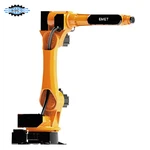


CNC Loading And Unloading Robot
The CNC Loading and Unloading Robot automates raw part loading, finished part unloading, and material transfer between CNC machines and downstream processing stations. By replacing manual handling, this system optimizes spindle utilization, reduces cycle downtime, and enables continuous 24/7 automated manufacturing.
Designed for maximum flexibility, the system can be integrated with CNC lathes, turning centers, vertical/horizontal machining centers (VMC/HMC), and grinding machines, serving either a single machine or multi-machine cells.
Technical Specifications
|
Item |
Specification |
|
Robot Type |
6-Axis Industrial Robot |
|
Robot Payload |
6–50 kg, depending on configuration |
|
Maximum Reach |
Approx. 1,400–2,600 mm |
|
Repeatability |
Approx. ±0.02–±0.05 mm |
|
Recommended Workpiece Weight |
Approx. 0.5–30 kg, application dependent |
|
Robot Mounting |
Floor / Side / Customized |
|
Gripper Type |
Pneumatic / Electric / Customized |
|
Gripper Configuration |
Single / Dual / Multi-Part |
|
CNC Communication |
Digital I/O / Ethernet / Fieldbus |
|
Supported Protocols |
Modbus TCP / PROFINET / EtherNet/IP or other supported protocols |
|
CNC Door Control |
Automatic, when compatible |
|
Chuck Control |
Through CNC interface |
|
Part Detection |
Proximity / Pressure / Photoelectric / Vision |
|
Pneumatic Pressure |
Typically 0.5–0.7 MPa |
|
Control Voltage |
Typically 24 VDC |
Key Automation Advantages
Increased Spindle Utilization: Eliminates operator fatigue and loading delays, increasing daily machine uptime.
Consistent Quality & Precision: Programmable robot paths ensure repeatable part placement without fixture wear or misalignments.
Labor Reallocation: Operators switch from repetitive manual loading to high-value tasks (tool setting, programming, quality control).
Unattended Operation: Supports lights-out manufacturing during off-shifts and weekends.
Applicable Components
Shafts & Axles: Motor shafts, drive pins, splines.
Rotational Parts: Bushings, bearing rings, rollers, flanges, hubs.
Prismatic Parts: Valve bodies, pump housings, hydraulic manifolds, brackets.
Custom Hardware: Fasteners, fittings, aerospace fittings, medical implants.
Automated CNC Loading and Unloading Sequence
Raw Part Feeding: Workpieces are presented via tray, pallet, conveyor, or gravity rack in a defined pick orientation.
Raw Part Picking: The robot picks the workpiece. Sensors verify proper grip and part presence before entering the machine.
CNC Interlock Signal: Upon cycle completion, the CNC controller sends a "Machine Ready" signal to the robot.
Finished Part Unloading: The automatic door opens; the robot enters the machining envelope and unclamps the finished part.
Raw Part Loading: The robot loads the raw part into the fixture/chuck and triggers the clamping mechanism.
Machining Restart: The robot exits the envelope, safety signals clear, the door closes, and the CNC resumes machining automatically.
Part Discharge & Transfer: The finished part is delivered to a tray, conveyor, washing, deburring, or inspection station.
End-of-Arm Tooling & Gripper Options
Gripper Technologies
Pneumatic Grippers: High speed, robust mechanical structure, ideal for standardized industrial environments.
Electric Servo Grippers: Programmable stroke, variable gripping force, suitable for delicate, thin-walled, or multi-size parts.
Tooling Configurations
Single Gripper: Cost-effective setup for longer machining cycles where part-exchange speed is not the primary bottleneck.
Dual Gripper (Fast Exchange): Holds a raw part and a finished part simultaneously. Reduces part-exchange time down to 3–8 seconds by eliminating intermediate travel during machine door opening.
Custom Jaw Profiles: Internal expanding jaws, external clamping jaws, magnetic grippers, or non-marking rubber pads tailored to specific part geometries.
Machine Communication & System Signals
Machine Status: CNC Ready, Machining Complete, Door Open/Closed, Chuck Clamped/Unclamped.
Robot Command: Robot In Safe Position, Request Door Open, Request Chuck Release, Cycle Start.
Safety & Monitoring: Emergency Stop Circuit Interlock, Gripper Pressure Lost, Part Seating Error, Guard Door Open.
Information Required for a Custom Technical Proposal
To help us design an optimized solution for your facility, please provide the following:
CNC Machine Details: Brand, model, controller type, and auto-door/chuck options.
Workpiece Data: Drawings (STEP/PDF), dimensions, raw/finished weight, and material.
Process Info: Current machining cycle time, target production volume, and photos of raw/finished parts.
Factory Constraints: Available floor space layout and preferences for part feeding (trays, conveyors, pallets).
FAQ
Hot Tags: cnc loading and unloading robot, China cnc loading and unloading robot manufacturers, factory
Next
No InformationYou Might Also Like




Send Inquiry