



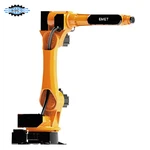

Palletizing Robots
Palletizing Robots for Automated Industrial Material Handling
Established in 2005, EMET operates a 3,200+ m² manufacturing facility in Baoding, Hebei, China, with more than 100 employees and over 19 years of manufacturing experience. The company operates under an ISO9001 quality management system and provides CE-certified products for applicable markets.
EMET palletizing robots are designed for repetitive end-of-line handling of cartons, cases, bags, boxes, trays, drums, containers, and other packaged products.


19+ Years of Manufacturing Experience
With nearly two decades of production history, EMET has established mature assembly, machining, and testing capabilities for industrial automation equipment.
Application-Based Configuration
Robot payload and reach are selected based on complete operational parameters (product mass, end-effector weight, stack height, and cell footprint)-preventing selection errors caused by looking at robot payload alone.
Customized Mechanical Engineering
Grippers, conveyor routing, positioning fixtures, and physical interfaces are tailor-designed according to your specific package profiles and line layouts.
Quality & International Compliance
EMET operates strictly under an ISO 9001 quality management system and supplies CE-compliant equipment for global distribution.
Export-Oriented Service & Logistics
Full support for overseas buyers, including direct bilingual technical communication, production updates, reinforced export packaging, container loading, and complete shipping documentation.
Technical Specifications
|
Parameter |
Standard Configuration Range |
|
Robot Type |
4-Axis / 6-Axis Articulated |
|
Robot Payload |
40 – 250+ kg (Model dependent) |
|
Working Reach |
1,800 – 3,200 mm |
|
Repeatability |
±0.05 – ±0.20 mm |
|
Product Handling Weight |
5 – 180+ kg |
|
Max Pallet Footprint |
Commonly up to 1,200 × 1,200 mm |
|
Stacking Height |
Up to 2,400 mm (Base on pedestal & reach) |
|
Product Detection |
Photoelectric / Laser proximity sensors |
|
End Effectors |
Vacuum / Mechanical Clamp / Fork / Custom Bag Gripper |
|
System Control |
Integrated Robot Controller + Siemens / Mitsubishi PLC & HMI |
|
Safety Compliance |
ISO 13849-1 / CE Safety Guarding & Light Curtains |
|
Communication |
Profinet / EtherNet/IP / Modbus / Digital I/O |
|
Power Requirement |
380V–415V AC, 3-Phase, 50/60 Hz |
Product Advantages
Eliminate Manual Strain:
Automates heavy, repetitive lifting, reducing workplace injury risks.
Consistent Stack Geometry:
Ensures neat, uniform pallet loads optimized for stretch wrapping and shipping container space.
Flexible Recipe Switching:
Change between package sizes and pallet patterns instantly via HMI touch-screen presets.
Seamless Line Connection:
Easily links with existing packaging, strapping, wrapping, and ERP/MES tracking systems.
Industry Applications
Self-constructed closed loop of industrial integration
Cartons & Cases: Food products, beverages, household chemicals, electronics, and logistics distribution.
Powerful Brand Influence
Bags & Sacks: Cement, fertilizers, plastic resins, animal feed, flour, and agricultural powders.

25 Years of Deep Technology Accumulation
Drums & Containers: Chemical barrels, liquid containers, lubricant pails, and industrial buckets.
Integrating the robotics ecosystem
Building Materials: Tile boxes, packaged hardware, insulation blocks, and construction supplies.
Palletizing Patterns and Stacking Methods
Optimized stacking patterns prevent load shifting during transit:
Column Stacking:
Aligns packages vertically. Ideal for maximum vertical compression strength on rigid cartons.
01
Interlocking Pattern:
Alternates package orientation by 90 degrees between layers to lock products together.
02
Brick Pattern:
Offsets joints between layers similar to masonry, enhancing stack stability for uniform boxes.
03
Cross Stacking:
Rotates orientations across multi-layer designs for high-tier bag and container loads.
04
Custom Patterns:
Software-programmable layouts tailored for mixed pallet loading or irregular package sizes.
05
Operating Sequence: How the Cell Works
Product Infeed -> Sensor Detection -> Pick-Up -> Transfer & Orientation -> Layer Formation -> Pallet Completion -> Pallet Removal
Product Infeed: Products enter via automated conveyor lines with controlled spacing.
Detection & Alignment: Sensors verify package arrival, orientation, and pick-point coordinates.
Pick-Up: Robot positions end effector and engages suction, clamping, or bottom support.
Transfer & Rotation: Robot moves product along a smooth path, rotating it mid-air to match the recipe pattern.
Placement & Layering: Product is placed on the pallet; layers build sequentially up to max height.
Pallet Discharge: Finished pallet is transferred via conveyor to downstream wrapping or manual forklift pickup.
How to Select the Right Palletizing Robot
Selecting a robot based only on product weight can lead to installation failure. The total handling cycle must be calculated:
Product Weight -> Total Robot Payload: Calculate the weight of the product PLUS the end-of-arm tooling (gripper). If a bag weighs 40 kg and the clamp weighs 15 kg, you require a minimum 60 kg payload rating.
Pallet Footprint -> Robot Reach: Reach must account for conveyor distance, total pallet width, maximum stacking height, and safety perimeter clearances.
Production Speed -> Cycle Rate: Evaluate required output (e.g., products per hour, pallets per hour) to determine required robot axis acceleration, gripper actuation speed, and conveyor feed rates.
Product Material -> Gripper Type: Structural rigidity, porousness, and surface texture determine whether vacuum, mechanical clamping, or bottom-fork support is required.
Layer Stacking -> Pattern Programming: Confirm whether column, interlocking, or custom layer rotation is needed for transportation stability.
Floor Layout -> Cell Footprint: Factor in safety fence boundaries, forklift loading zones, pallet dispenser placement, and maintenance clearance.

Custom EoAT & Palletizing Grippers
The gripper design directly impacts pick speed and product safety:
Vacuum Grippers:
Best for rigid, smooth-surfaced products like closed cartons, sealed cases, and rigid boards.
Mechanical Clamp Grippers:
Secures items from the sides; ideal for non-porous containers, open trays, and crates.
Fork-Type Grippers:
Supports heavy or weak-bottomed products from underneath to prevent sagging or rupture.
Bag Grippers:
Specialized clamps designed for filled bags (cement, grain, chemicals) where bulk material shifts during motion.
Customized Hybrid Grippers:
Combines vacuum and mechanical clamping for lines running multiple product variations.
Industrial Export Packaging
Protective anti-moisture barrier film wrapped around robot arm and cabinet.
Shock-absorbing padding and heavy-duty reinforced wooden crates.
Steel-frame base reinforcement for secure forklift and container loading.
Clearly marked spare parts and modular sub-assemblies for easy reassembly.

Factory Acceptance Testing
Before dispatch, every EMET palletizing cell undergoes strict Factory Acceptance Testing in our Baoding facility:
Mechanical & Electrical Audit:
Inspection of torque specifications, cable routing, and terminal connections.
Functional Testing:
Sensor response verification, pneumatic pressure hold tests, and emergency stop circuit safety checks.
Trial Load Run:
Complete continuous trial operating cycle using customer-supplied or simulated product samples to verify cycle time, pick accuracy, and pattern stability.
FAQ