



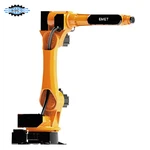

Welding Robots
Custom Industrial Welding Robots & Automated Robotic Cells Manufacturer | EMET
EMET manufactures industrial welding robots and customized robotic welding systems for repetitive metal joining applications.
Our systems are configured according to your workpiece, material, welding process, production volume, and factory layout. The product range includes 6-axis welding robots, robotic MIG/MAG welding systems, robotic TIG welding systems, robotic laser welding systems, robotic spot welding systems, and customized automated welding cells.
With manufacturing experience since 2005, a production facility of over 3,200 m², and more than 100 skilled employees, EMET supplies industrial machinery to international B2B customers, supporting customized engineering and export requirements.


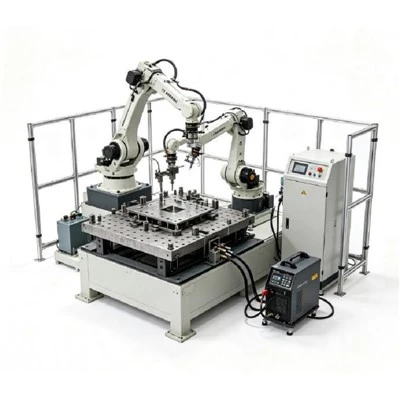


In-House Manufacturing:
Full quality control over equipment manufacturing, sub-assembly, integration, and trial welding.
Application-Based Configuration:
Robot payload, working radius, process tools, fixtures, and positioners selected specifically for your workpiece.
Turnkey Cell Integration:
Seamless coordination between robot arm, welding power supply, fixtures, safety interlocks, and master PLC controls.
Customized Engineering:
Adaptable to non-standard workpiece dimensions, tight factory footprints, and specialized welding sequences.
Export Support:
Professional export packaging (moisture-proof, shock-absorbing) and complete shipping documentation for international logistics.
Specifications
|
Parameter |
Published Specification |
|
Available Payload |
50 kg / 100 kg |
|
Maximum Working Radius |
Up to 2,732 mm |
|
Positioning Repeatability |
±0.08 mm |
|
Protection Class |
IP63 |
|
Robot Weight |
Approx. 655 kg |
|
Operating Temperature |
0–45°C |
|
Relative Humidity |
20–80%, non-condensing |
|
J1 Range |
±165° |
|
J2 Range |
+80° / -90° |
|
J3 Range |
+105° / -75° |
|
J4 Range |
±180° |
|
J5 Range |
+98° / -90° |
|
J6 Range |
±360° |
|
J1 Maximum Speed |
140°/s |
|
J2 Maximum Speed |
Approx. 90–93°/s |
|
J3 Maximum Speed |
Approx. 108–111°/s |
|
J4 Maximum Speed |
205°/s |
|
J5 Maximum Speed |
295°/s |
|
J6 Maximum Speed |
465°/s |
|
Listed Power Capacity |
5.0 kVA |
|
I/O |
9-core I/O cable |
|
Gas Circuit |
1 |

Key Features of EMET Welding Robots
Modular Automation Upgrades:
Easily upgraded with laser seam-tracking sensors to auto-compensate for thermal warping or part tolerance variations.
Multi-Axis Flexibility:
6-degree-of-freedom motion allows push/drag angle optimization even inside restricted enclosure frames.
Robust Payload Margins:
50kg and 100kg platform capacities ensure stability when carrying heavy laser heads, double-wire torches, or spot-welding guns.
Extensible Fieldbus Integration:
Supports standard industrial protocols (Profinet, DeviceNet, EtherNet/IP) for seamless handshake with factory PLCs.
Precision Workholding Coordination:
Syncs movement directly with servo-driven external positioners for continuous 360° circular seam welding.
Core Components of a Complete EMET Welding Cell
A fully functional automated welding cell integrates ten main elements:
Robot Manipulator: Executes high-precision physical motion.
Master Controller: Handles trajectory math, I/O signals, and welding sequence logic.
Welding Power Source: Supplies regulated arc or laser energy.
Welding Torch / Laser Head: Delivers energy and shielding gas to the joint.
Wire Feeding Unit: Drives consumable wire smoothly to the arc zone.
Custom Fixture/Jig: Holds the workpiece rigid to prevent heat distortion.
Servo Positioner: Rotates the part to maintain down-hand welding orientation.
Safety Enclosure: Protects workers via light curtains, interlocks, and flash-shield panels.
Fume Extraction System: Removes harmful metal fumes at the source.
Seam Tracking / Vision (Optional): Dynamically adjusts torch path for seam deviation.
General Metal Fabrication: Structural frames, machine bases, sheet enclosures, structural brackets.
Automotive & Transit: Chassis brackets, exhaust manifolds, tubular assemblies, seat frames.
Agricultural Machinery: Heavy chassis frames, boom arms, tiller assemblies, plow bodies.
Construction Equipment: Support struts, bucket linkages, heavy structural mounts.
Steel & Aluminum Structures: Repetitive beam joining, floor grating, modular housing frames.

Welding Process Options
Selection depends on metal type, wall thickness, joint design, and aesthetic requirements.
MIG/MAG Welding:
High-speed wire feeding process ideal for carbon steel, structural steel, and thick aluminum plates. Common in machine frames, trailers, and building structures.
TIG Welding:
Provides an ultra-clean, spatter-free weld bead with precise thermal control. Ideal for thin stainless steel, food-grade equipment, and aerospace fittings.
Laser Welding:
Extremely narrow heat-affected zone (HAZ) preventing metal distortion at high travel speeds. Ideal for thin sheet assemblies, aluminum grating, and precision sensors.
Spot Welding:
Efficient resistance welding for overlapping sheet metals without filler wire. Ideal for automotive panels, metal cabinets, and home appliance shells.
How an Automated Welding Cell Works
Loading: The raw workpiece is loaded into the station manually or via automated handling.
Fixturing: Quick-clamp pneumatics or manual toggles secure the part in exact zero-point alignment.
Robot Positioning: The robot arm swiftly travels to the pre-programmed arc-start position.
Welding: The power supply and torch execute the weld sequence with synchronized speed and gas coverage.
Inspection: The operator or automated vision sensor verifies weld completeness and bead profile.
Unloading: The finished weldment is unclasped and cleared for downstream processing.
Selects and Configures Your Robot System
You do not need to know exact robot model numbers before contacting us. We engineer the cell based on your product data through a 5-step evaluation:
Workpiece Parameters
Dimensions (L x W x H), weight, base metal type, and wall thickness.
01
Welding Specifications
Seam locations, joint types (butt, lap, fillet), total seam length, and visual standards.
02
Production Targets
Required output per shift/day, shift structure, and target cycle time per part.
03
Plant Conditions
Available floor space, main power supply, ventilation, and crane access.
04
System Engineering
EMET evaluates payload, reach, power supply model, fixture clamping, and safety layouts, presenting a complete technical proposal.
05

Prior to shipment, every integrated cell undergoes complete FAT testing at our facility, including:
Multi-axis robot motion and logic sequence validation.
Full-power trial welding on customer-supplied sample parts.
Positioner synchronization and fixture clamping checks.
Safety system interlock and emergency stop tests.
International Export Packaging & Shipping
Protection:
Heavy-duty, ISPM-15 compliant sea-worthy wooden cases with vacuum-sealed moisture barrier and anti-vibration padding.
Securing:
Mechanical lock-down of robot joints to prevent internal gear damage during transit.
Documentation:
Clear packing lists, electrical schematics, operating manuals, and customs clearance paperwork provided.
FAQ