



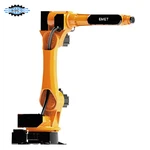


Industrial Welding Robot
The Industrial Welding Robot is a 6-axis articulated robotic system engineered for high-precision, automated MIG, MAG, TIG, and arc welding applications. Featuring a versatile 6-axis kinematic design, the robot arm delivers full pitch, roll, and yaw control of the welding torch. This ensures optimal torch orientation across complex geometries, including corner joints, inclined seams, internal spatial welds, and multi-directional weldments.
Technical Specifications
|
Parameter |
Typical Specification |
|
Robot Type |
6-Axis Articulated Robot |
|
Application |
Robotic Welding |
|
Number of Axes |
6 |
|
Payload |
6–12 kg |
|
Maximum Reach |
1,500–2,100 mm |
|
Position Repeatability |
±0.05 mm Typical |
|
Drive System |
AC Servo Drive |
|
Control Method |
Continuous Path Control |
|
Welding Processes |
MIG / MAG / TIG / Arc Welding |
|
Welding Torch |
Selected According to Welding Process |
|
Welding Power Source |
Configurable |
|
Wire Feeder |
Configurable |
|
Workpiece Positioner |
Optional |
|
External Axis |
Optional |
|
Mounting |
Floor Mounting; Other Configurations Available |
|
Programming |
Teach Pendant |
|
Robot Controller |
Dedicated Robot Controller |
|
Communication |
Industrial Communication Interface |
|
Safety System |
Safety Fence, Interlock and Emergency Stop |
|
Operating Temperature |
Typically 0–45°C |
|
Installation Environment |
Indoor Industrial Environment |
|
Power Supply |
According to Robot and Welding Equipment |
Key Kinematic Advantages
Multi-Directional Weld Access: Smoothly transitions between horizontal, vertical, overhead, corner, and internal tube joints in a continuous cycle.
Optimized Push/Drag Angles: Maintains precise torch angles relative to the joint line, minimizing spatter, porosity, and undercut defects.
Synchronized Positioner Motion: Coordinates axis movement with rotary tables, placing the weld joint in the flat position for optimal bead profile.
Linear Workspace Expansion: Mountable on external linear tracks to weld large structural beams or multi-station layouts.
Key Application Sectors
Agricultural Machinery: Chassis structures, implement frames, cutter bars, bracket sub-assemblies.
Construction Equipment: Boom arms, buckets, excavator frames, cab supports, structural brackets.
Automotive and Transportation: Axle housings, cross members, seat frames, exhaust systems, bumper supports.
Industrial Machinery and HVAC: Machine bases, conveyor frames, motor housings, pressure vessels, steel enclosures.
Structural Metal Fabrication: Architectural posts, steel trusses, tubular gates, material handling racks.
Robotic Welding Cell System Architecture
A complete, high-productivity robotic welding station incorporates the following core sub-systems:
6-Axis Robot Arm: Controls torch trajectory and velocity along the spatial path.
Dedicated Robot Controller: Manages motion kinematics, process I/O, safety loops, and network communications.
Teach Pendant: Handheld unit used for path teaching, parameter adjustment, weld recipe management, and diagnostics.
Welding Power Source: Delivers stable current/voltage profiles (pulsed, double-pulsed, or short-arc).
Precision Wire Feeder: Ensures accurate, slip-free wire delivery to the torch tip.
Welding Torch and Harness: Designed for high duty cycles with integrated anti-collision protection.
Workpiece Positioner: Rotates or tilts the workpiece for optimal weld pool control.
Custom Welding Fixture: Clamps and locates components accurately to prevent heat distortion during welding.
Integrated Safety Enclosure: Features perimeter fencing, interlocked access doors, safety curtains, and emergency stop circuits compliant with international standards.
Supported Welding Processes
MAG Welding (Metal Active Gas): The primary choice for carbon steel and low-alloy structural steel fabrication (e.g., frames, brackets, chassis parts).
MIG Welding (Metal Inert Gas): Ideal for non-ferrous alloys including aluminum, stainless steel, and copper assemblies.
TIG Welding (Tungsten Inert Gas): Provides precise heat control and superior aesthetic finish for thin-gauge stainless steel, piping, and critical visual components.
Automated Arc / Flux-Cored Welding: Designed for deep penetration and high deposition rates on heavy plate components.
Smart Automation and Optional Upgrades
Boost productivity and compensate for real-world manufacturing variations with these optional functional modules:
Touch Sensing (Initial Joint Finding): Uses the torch tip or wire to detect workpiece position shifts before striking the arc, adjusting the start point automatically.
Arc / Laser Seam Tracking: Dynamically adjusts the robot trajectory during welding to follow joint gaps or thermal distortion.
Automatic Torch Cleaning Station: Cleans spatter, injects anti-spatter fluid, and trims wire automatically to extend consumable life.
Anti-Collision Sensor: Protects the torch and wrist mechanism by stopping motion instantly upon unexpected physical contact.
Automatic TCP Calibration: Re-calibrates Tool Center Point in seconds after nozzle maintenance, avoiding path re-teaching.
Multi-Station Layout: Allows the operator to load and unload station B while the robot welds on station A, maximizing arc-on time.
Standard Operating Workflow
Part Loading: Operator or handling robot places raw components into the designated fixture.
Fixture Clamping: Pneumatic or hydraulic clamps secure the parts in precise orientation.
Program Selection: The operator selects the matching recipe on the teach pendant or main cell HMI.
Sensing & Alignment (Optional): Touch sensing or laser vision verifies joint locations and compensates for tolerances.
Automated Welding: Robot executes programmed trajectories while the power source maintains arc parameters.
Coordinated Positioning: Positioner indexes dynamically to bring secondary joints into optimal welding orientation.
Cycle Completion & Clean: Torch returns to home position; automatic torch cleaner runs if scheduled.
Unloading & Inspection: Fixture unclamps; finished weldment is removed for visual or NDT inspection.
Global Service & Engineering Support
Pre-Sale Feasibility: Free workpiece CAD review, joint access analysis, and 3D cycle time simulation.
Turnkey Delivery: Pre-wired, pre-tested cell assemblies shipped ready for floor mounting and commissioning.
Training & After-Sales: Multi-language technical support, remote cloud diagnostic capabilities, and rapid spare parts dispatch.
FAQ
Hot Tags: industrial welding robot, China industrial welding robot manufacturers, factory, Compact Palletizing Robot
Previous
6-Axis Welding RobotNext
No InformationYou Might Also Like


Send Inquiry