



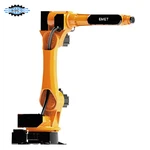


MIG/MAG Welding Robot
The 6-Axis Robotic MIG/MAG Welding System is an industrial automation solution designed for high-repeatability, multi-pass, and continuous seam welding. By integrating an industrial robot arm, advanced MIG/MAG power source, wire feeder, positioning equipment, and safety enclosures, this turnkey cell transforms labor-intensive manual welding into a standardized, high-efficiency manufacturing process.
Technical Specifications
|
Item |
Typical Specification |
|
Welding Process |
MIG / MAG / GMAW |
|
Robot Structure |
6-axis articulated robot |
|
Robot Payload |
6–25 kg |
|
Robot Reach |
1,400–2,600 mm |
|
Repeatability |
±0.02–0.08 mm |
|
Welding Current |
250–500 A |
|
Welding Voltage |
16–40 V |
|
Wire Diameter |
0.8–1.6 mm |
|
Wire Feed Speed |
2–20 m/min |
|
Welding Torch |
Air-cooled / Water-cooled |
|
Shielding Gas |
CO₂ / Ar-CO₂ / Application-specific |
|
Positioner Type |
Rotary / Tilting / Headstock-Tailstock / Multi-Axis |
|
Positioner Capacity |
250–4,000 kg |
|
Positioner Axes |
1–5 axes |
|
Drive System |
Servo |
|
Touch Sensing |
Optional |
|
Arc Seam Tracking |
Optional |
|
Torch Cleaning |
Optional |
|
TCP Calibration |
Optional |
|
External Axis |
Optional |
|
Dual Station |
Optional |
|
Safety Protection |
Fence / Interlock / Light Curtain / Scanner |
|
Fume Extraction |
Optional |
|
Power Supply |
Commonly 3-phase 380/400 V, 50/60 Hz |
Practical Operational Advantages
Consistent Weld Quality & Aesthetics
The robot replicates exact programmed travel speeds, torch angles, and arc lengths cycle after cycle. This eliminates variations common in manual welding and produces uniform bead appearance and penetration.
Multi-Directional Torch Access
A 6-axis jointed robot combined with a synchronized 1-axis or 2-axis positioner rotates and tilts the workpiece, ensuring all welds are executed in the optimal down-hand (1F/1G) position.
Labor Optimization & Operator Safety
Transfers tedious, hot, and dangerous welding duties to an automated system. Operators focus primarily on loading, unloading, quality inspection, and secondary tasks-improving shop floor ergonomics and safety.
Scalable Production & Easy Changeovers
System parameters, welding programs, and custom fixtures can be saved and recalled for different product runs, making it feasible to scale from single-part families to broader product lineups.
Industry Applications
Agricultural & Earthmoving Equipment: Tractor frames, boom arms, hitch mechanisms, brackets.
Construction & Heavy Machinery: Excavator sub-assemblies, machine bases, mounting plates.
Automotive & Transportation: Axle housings, trailer chassis, cross-members, seating frames, exhaust systems.
General Metal Fabrication: Structural steel assemblies, pressure vessels, enclosures, industrial furniture, pipe flanges.
Robotic Cell Component Breakdown
Industrial Robot Arm: 6-axis articulated manipulator providing high speed and path repeatability.
Welding Power Source & Wire Feeder: Digital synergic pulse power source (350–500 A) with smooth wire delivery.
Torch Assembly: Air-cooled (standard) or Water-cooled (heavy-duty/high current).
Positioning System: 1-to-5 axis servo-driven positioners fully synchronized with robot motion.
Workpiece Fixturing: Custom mechanical or pneumatic fixtures ensuring repeatable part location.
Safety Infrastructure: Perimeter fencing, safety light curtains, interlocked service doors, arc shielding, and status beacons.
Auxiliary Equipment: Automatic torch cleaning station (reamer/anti-spatter spray), wire cutter, and fume extraction hoods.
Materials, Shielding Gas, & Joint Compatibility
The system supports a wide range of industrial metal fabrication needs:
Carbon Steel (Mild Steel): Ideal for machine frames, agricultural implements, trailer chassis, and structural brackets. Typically uses Ar/CO₂ mixed gas or pure CO₂.
Stainless Steel: Ideal for food/chemical equipment frames, enclosures, and structural assemblies. Requires precise heat control, stainless wire, and appropriate mixed shielding gas to prevent distortion and corrosion.
Aluminum Alloys: Ideal for lightweight frames and transport structures. Utilizes specialized pulse MIG power sources, push-pull torches, smooth wire feeders, Teflon liners, and pure Argon gas.
Positioner Selection Matrix
Rotary Positioner (1-Axis): Best for pipes, flanges, circular assemblies, and symmetrical frames.
Tilting / 2-Axis Positioner: Ideal for box structures, machine bases, and multi-sided weldments requiring 3D reorientation.
Headstock-Tailstock Positioner: Designed for long, heavy structural frames, trailers, and cylindrical tanks.
Multi-Axis Servo Positioners: Synchronized continuous rotation coordinated with robot motion for complex 3D contoured seams.
Optional Automation Modules
Touch Sensing: The gas nozzle or wire physically contacts key workpiece features to offset robot path coordinates for part variation before arc-on.
Arc Seam Tracking (Thru-Arc Seam Tracking): Real-time path adjustment during welding by monitoring arc current/voltage changes across the joint.
Automatic Torch Cleaning Station: Mechanically cleans spatter from inside the nozzle, sprays anti-spatter fluid, and trims the wire end automatically.
TCP Calibration System: Re-calibrates the Tool Center Point automatically after collision or tip maintenance to preserve path precision.
External Motion Tracks: Mounts the robot on a linear rail to extend working range along long fabrications.
Routine Maintenance Items
Daily: Inspect gas nozzle cleanliness, check anti-spatter fluid level, verify wire feed rolls and tip wear.
Weekly: Clean wire conduit liners, inspect cable package flexibility, verify emergency stop circuits.
Scheduled: Robot gear grease replacement, positioner backlash inspection, safety interlocking checks.
FAQ
Hot Tags: mig/mag welding robot, China mig/mag welding robot manufacturers, factory, Compact Palletizing Robot
Previous
Spot Welding RobotYou Might Also Like


Send Inquiry