



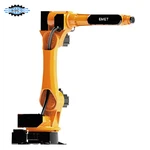


Robotic Welding Workstation
The Integrated Robotic Welding Workstation is a fully automated, turnkey cell engineered for manufacturers requiring high repeatability, tight weld tolerances, and maximum arc-on time.
Rather than supplying standalone components, we engineer the entire ecosystem-robot, power source, workpiece positioner, precision fixture, safety interlocks, and cell controls-to work as a synchronized unit tailored to your specific production requirements.
Key Specifications
|
Parameter |
Typical Range |
|
Robot Payload |
6–25 kg |
|
Robot Reach |
1,400–2,000 mm |
|
Repeatability |
Approx. ±0.05–0.08 mm |
|
Welding Process |
MIG / MAG / CO₂ |
|
Welding Current |
350–500 A |
|
Positioner Capacity |
250–1,500 kg |
|
Positioner Rotation |
360° Continuous or Programmable |
|
Positioner Tilting |
Up to ±90°, depending on model |
|
Fixture |
Dedicated / Modular / Customized |
|
Cell Layout |
Single Station / Dual Station |
|
Seam Tracking |
Optional |
|
Torch Cleaning |
Optional |
|
Linear Robot Axis |
Optional |
Key Advantages
Repeatable Quality: Eliminates variations in travel speed, torch angle, and heat input.
360° Accessibility: The 6-axis robot and positioner combo easily reaches multi-face welds on complex assemblies.
Reduced Labor Dependency: Operators shift from physically demanding welding to supervision, loading, and quality inspection.
Multi-Program Flexibility: Store hundreds of programs. One workstation can process multiple product models by simply switching modular fixtures and selecting a new program.
Maximized Arc-On Time: In dual-station setups, the robot welds Station A while the operator unloads/loads Station B, virtually eliminating wait times.
Typical Applications
Structural & Heavy Equipment: Machine bases, steel frames, booms, equipment supports.
Automotive & Transportation: Chassis brackets, suspension supports, exhaust components.
Agricultural Machinery: Frames, attachments, tubular structures, linkages.
Industrial & General Metal Fabrication: Pipe assemblies, flanges, metal racks, enclosures, tubular furniture.
Comprehensive Subsystem Integration
6-Axis Articulated Welding Robot: Controls torch orientation along complex 3D paths, providing multi-angle access to intricate joint configurations.
Welding Power Source & Torch: Regulates arc parameters, voltage, current, and wire feed speed; available with air-cooled or water-cooled torch setups.
Servo Positioner: Rotates or tilts the assembly dynamically to ensure welds are executed in flat or horizontal positions for optimal bead appearance and penetration.
Precision Welding Fixture: Locates and clamps components precisely, preventing heat deformation and ensuring repeatable alignment relative to the robot tool center point.
Central Robot Controller: Synchronizes multi-axis motion between the robot and positioner while executing automated welding sequences.
Integrated Safety Guarding: Protects operators via interlocked perimeter fencing, emergency stops, safety curtains, and optional integrated fume extraction hoods.
Operational Workflow
Workpiece Loading: The operator places raw metal components into the fixture, aligning them against hard locating points and reference pins.
Workpiece Clamping: Toggle clamps, pneumatic cylinders, or hydraulic clamps secure the assembly in place to maintain part location and control thermal expansion during welding.
Joint Verification (Optional Sensing): If specified, touch sensing or laser optical sensors verify the start-point location, compensating for minor dimensional variations in incoming raw materials.
Coordinated Welding Execution: The robot initiates the arc and follows the programmed trajectory while the positioner dynamically tilts or rotates the workpiece to maintain optimal torch angle.
Cycle Completion & Station Maintenance: Upon finishing the weld, the robot returns to home position. The system can automatically perform torch reaming, anti-spatter spraying, and wire trimming prior to unloading.
Optional Automation Upgrades
Enhance workstation productivity and process autonomy with modular add-ons:
Laser Seam Tracking: Real-time optical joint tracking to compensate for fit-up gaps and part variations.
Touch Sensing: Uses the welding wire or gas cup to locate part position prior to arc ignition.
Automatic Torch Cleaner & Wire Cutter: Extends nozzle life and ensures reliable arc starting.
Integrated Fume Extraction Hood: Connects to central dust collection systems for cleaner shop floor air.
Quick-Change Tooling Plates: Enables rapid fixture swaps for high-mix, low-volume production runs.
Engineering Execution: From Drawing to Turnkey Cell
Workpiece Assessment: Engineering evaluation of 2D/3D CAD models, material thickness, joint access, and cycle time targets.
Cell & Kinematics Configuration: Selecting the optimal robot model, positioner payload, power source, and cell footprint.
Custom Fixture Tooling: Engineering dedicated locate and clamp fixtures for reliable part positioning.
Offline Programming & Simulation: Simulating reachability, collision checking, and cycle time optimizations.
Factory Acceptance Testing: Performing dry runs, mechanical validation, and sample production welds prior to shipment.
On-Site Installation & Training: Final commissioning, safety integration, and operator programming training.
FAQ
Hot Tags: robotic welding workstation, China robotic welding workstation manufacturers, factory
Previous
MIG/MAG Welding RobotYou Might Also Like


Send Inquiry