



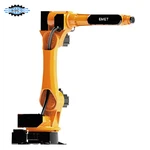


Mechanical Assembly Assist Manipulator
The Mechanical Assembly Assist Manipulator is an operator-guided material handling system designed to lift, tilt, rotate, and precisely position industrial components. By supporting the full load weight through an articulated rigid arm, it eliminates manual physical strain while leaving exact positioning control in the operator's hands. Each system is engineered around the workpiece weight, load center, working radius, tooling requirements, and workstation layout.
Technical Specifications
|
Parameter |
Configuration Range / Options |
|
Rated Load Capacity |
20 – 1,000 kg (Includes tooling weight & dynamic torque) |
|
Maximum Working Radius |
Up to 4,000 mm |
|
Minimum Working Radius |
From ~700 mm |
|
Vertical Travel Envelope |
Application-dependent (Customizable stroke) |
|
Rotation Range |
Up to 360° continuous or limited swivel |
|
Arm Construction |
Rigid articulated arm / High-strength structural alloy |
|
Operation Type |
Manual operator-guided with force assistance |
|
Mounting Options |
Floor-mounted column, overhead suspended, or ceiling track mount |
|
Assistance Mechanism |
Pure mechanical counterbalance or pneumatic-assisted configuration |
|
End Tooling Fixtures |
Mechanical clamp, hook, fork, vacuum suction, or custom fixture |
|
Workpiece Orientation |
Fixed, pitch-tilting, or 360° manual/powered rotation |
Key Operational Advantages
Ergonomic Risk Reduction: Transfers 100% of workpiece load to the arm, minimizing operator fatigue and back injury risks.
Tactile Alignment Precision: Direct hand-on-part control enables fine micro-adjustments during delicate assembly steps.
Moment-Balanced Design: Custom arm geometry accounts for offset load centers, preventing binding or deflection.
Workstation Space Optimization: Floor, overhead, or mobile mount options preserve floor space and operator pathways.
High ROI & Throughput: Accelerates handling cycles while safeguarding fragile, machined component surfaces.
Industry Applications
Automotive & Transportation: Positioning engines, gearboxes, door modules, and subframes.
HVAC & Industrial Ductwork: Handling large air tubes, blowers, compressor units, and sheet metal assemblies.
Heavy Machinery Manufacturing: Aligning cast pump housings, hydraulic cylinders, and drive shafts.
Metal Fabrication & Welding: Rotating welded structures for multi-angle joint access and inspection.
Machine Tooling & Loading: Loading heavy workpieces into CNC lathes and horizontal machining centers.
How the Manipulator Works
Pick Up: End-effector secures the workpiece via clamp, vacuum, or custom fixture.
Lift & Support: Mechanical/pneumatic balance negates workpiece and tooling weight.
Move & Orient: Operator manually guides the arm through the configured motion path.
Position & Fasten: Part is held securely in exact alignment for assembly operations.
Release: Interlocked pneumatic or mechanical safety controls release the part after verification.
Workstation Integration & Site Requirements
|
Integration Factor |
Engineering Information Required |
|
Mounting Surface |
Floor concrete depth/grade, overhead steel beam specs, or gantry layout |
|
Height & Clearance |
Min/max ceiling height and overhead obstacle layout |
|
Movement Path |
Precise coordinates of pickup, transit corridor, and final assembly point |
|
Utilities Needed |
Clean dry compressed air (5–7 bar) or electric power where applicable |
|
Safety Zone |
Operator standing zone and dynamic swing clearance radius |
End Tooling & Workpiece Interface
End-effectors are custom-built for specific component geometries, surface delicate requirements, and grip safety:
Mechanical Clamps: Rigid jaw gripping for structural castings and housings.
Hook & Clevis Fixtures: Quick-mount eyelet loading for shafts and frames.
Fork Attachments: Under-load support for flat-bottomed fabrications or pallets.
Vacuum Suction Tooling: Non-marring cup arrays for sheet metal, panels, and smooth covers.
Multi-Point & Custom Fixtures: Dedicated locating pins for complex, multi-axis parts.
Safety Protection & Interlocks
Anti-Drop & Load Retention: Mechanical latches or pneumatic check valves hold the load upon supply pressure loss.
Safety Brake Systems: Pneumatic or friction joint brakes lock movement when idle.
Dual-Action Release Controls: Requires deliberate two-hand operation to release clamped loads.
Travel Limit Stop Bumper: Mechanical stops prevent arm collisions with surrounding equipment.
Pressure Monitoring Interlocks: Prevents initial lifting if system pressure falls below threshold.
Customizable Elements
Rated capacity, arm length, horizontal reach, and vertical lift stroke.
Floor, overhead, or mobile mounting plates.
Tailored pneumatic or pure mechanical counterbalance systems.
Custom-engineered grippers, vacuum pads, or mechanical clamps.
Key Quality Testing Points
Weld integrity and dimensional accuracy of structural members.
Smoothness and resistance profile across all articulated joints.
End-effector holding force under maximum rated capacity.
Load-center moment stability at full maximum radius reach.
Verification of safety interlocks and emergency stop procedures.
FAQ
Hot Tags: mechanical assembly assist manipulator, China mechanical assembly assist manipulator manufacturers, factory, gantry mounted manipulator arm, gearbox controlled manipulator arm, keyway mounted manipulator arm, long reach manipulator arm, painting manipulator arm, pharmaceutical industry manipulator arm
Next
No InformationYou Might Also Like


Send Inquiry