



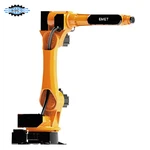


Pneumatic Material Handling Manipulator
The Pneumatic Material Handling Manipulator is a workstation-level lifting and positioning system designed for loads that are difficult, unsafe, or inefficient to move manually due to weight, dimensions, shape, or handling frequency.
A pneumatic balancing system creates a "zero-gravity" feel by supporting the suspended weight, while a rigid articulated arm guides precise movement. Unlike a standard overhead wire hoist that only moves vertically and allows loads to swing, this manipulator provides guided horizontal and vertical movement, allowing operators to effortlessly guide workpieces directly into CNC fixtures, welding jigs, pallets, or assembly line stations.
Technical Specifications
|
Parameter |
Standard / Baseline Specification |
|
Product Type |
Industrial Pneumatic Material Handling Manipulator |
|
Operating Principle |
Pneumatic zero-gravity load balancing |
|
Power Source |
Compressed air (Clean, dry air: 0.6 - 0.8 MPa) |
|
Noise Level |
Less than 70 dB(A) |
|
Operation Mode |
Manual guided handling with pneumatic weight support |
|
Standard Payload Range |
20 kg to 350 kg (Customizable up to 600+ kg upon engineering evaluation) |
|
Working Radius |
Standard 1,500 mm - 3,000 mm (Customizable) |
|
Vertical Stroke |
Standard 800 mm - 2,000 mm (Customizable) |
|
Arm Configuration |
Rigid articulated arm / Rigid vertical pillar type |
|
Mounting Options |
Floor-mounted pillar, ceiling-suspended, or overhead gantry/rail-mounted |
|
End Effector Options |
Mechanical gripper, vacuum suction, magnetic, hook, or custom tooling |
|
Rotational/Tilting Capability |
Manual/Pneumatic 90° / 180° / 360° (Subject to application) |
Key Advantages
Pneumatic Load Support: Reduces physical strain by over 90%, preventing workplace injuries and fatigue.
Rigid Arm Stability: Rigid arm construction prevents load swing, guaranteeing precise alignment into machine fixtures or tight assembly spaces.
Offset Load Capability: Tailored mechanical and pneumatic engineering allows safe handling of long, asymmetrical, or off-center workpieces.
Customized End Effectors: Tooling engineered specifically for your part geometry, surface quality, and material properties.
Seamless Integration: Compact footprint; adaptable to existing factory floor layouts, ceiling structures, or crane rails.
Industry Applications
CNC Machining Centers: Transferring raw castings and blocks from pallets into precise machine vise clamps.
Sheet Metal Fabrication: Loading laser cutters and press brakes using non-marking vacuum suction arrays.
Automotive Component Assembly: Handling engine blocks, transmission cases, and body panels along production lines.
General Metal Fabrication: Positioning structural frames and welded assemblies into welding positioners.
Glass & Panel Manufacturing: Safe, scratch-free transfer of large-format glass panes and architectural boards.
End Effector / Tooling Options
Vacuum Lifters: Non-marking pads, multi-zone pads (Best for flat sheet metal, glass, and smooth panels).
Magnetic Tooling: Permanent or electro-magnetic (Best for ferrous plates, blocks, and forgings).
Mechanical Grippers: OD/ID clamping, form-fit jaws (Best for cylinders, shafts, and tubes).
Hook Systems: Lifting eyes, custom pins (Best for fabricated parts with lifting holes).
Customized Fixtures: Multi-point clamping with multi-axis pitch/roll (Best for asymmetrical or irregular components).
Standard Handling Process
Grip: The operator positions the end effector on the workpiece and engages the clamp/suction.
Balance: The pneumatic system automatically senses or engages the pre-set pressure needed to support the combined mass of the workpiece and end effector.
Transfer & Position: The rigid arm eliminates load swinging. The operator manually guides the suspended load to its destination with minimal physical force, allowing precise micro-adjustments during loading or assembly.
Release: Once safely supported at the target position, the operator releases the grip sequence.
Safety Systems
Designed in accordance with international machinery safety standards to protect both operator and equipment.
Air-Loss Protection: Integrated check valves and load-retention circuits prevent the arm or load from dropping suddenly during an air supply interruption.
Pressure-Drop Monitoring: Sensors detect pressure fluctuations and lock movement axes if system air pressure falls below safe levels.
Misoperation Interlocks: Safety logic prevents accidental tool release while the workpiece is suspended in mid-air.
Buffer Air Storage: Integrated air reservoir tank maintains holding force during short-term supply fluctuations.
Installation & Mounting Configurations
Floor-Mounted Column: Free-standing, fixed anchor-bolt installation. Offers 360° rotation around a dedicated workstation.
Ceiling-Suspended: Mounted directly to structural I-beams or ceiling trusses to keep factory floor space entirely clear.
Overhead Rail-Guided: Suspended from a bridge crane or monorail track, allowing the manipulator to cover linear or multi-bay work areas.
FAQ
Hot Tags: pneumatic material handling manipulator, China pneumatic material handling manipulator manufacturers, factory, competitive manipulator arm, dust sensor guided manipulator arm, electric manipulator arm, fluid sensor guided manipulator arm, innovative manipulator arm, servo driven manipulator arm
You Might Also Like




Send Inquiry