



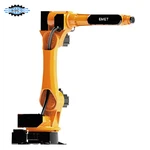


Pneumatic Balancer Manipulator
The Pneumatic Balancer Manipulator is an engineered ergonomic lifting system designed for controlled lifting, moving, and precise positioning of heavy, awkward, or offset workpieces within a defined working area.By utilizing compressed air to counterbalance the load, the articulated arm allows the operator to effortlessly guide components between pallets, CNC machines, assembly fixtures, conveyors, and transfer stations with zero-gravity float feeling.
Key Specifications
|
Specification |
Configuration / Standard Range |
|
Payload Capacity |
30 – 300 kg (Customizable up to 500 kg) |
|
Maximum Working Radius |
1,500 – 3,200 mm |
|
Vertical Lifting Stroke |
1,000 – 2,000 mm |
|
Working Air Pressure |
0.5 – 0.7 MPa |
|
Lifting Speed |
0 – 300 mm/s (Proportional control) |
|
Arm Rotation |
360° continuous / Limited according to model |
|
Column Rotation |
360° continuous / Limited according to model |
|
Mounting Options |
Floor-mounted column / Overhead track / Mobile base |
|
Gripping Options |
Hook / Mechanical Gripper / Vacuum Lifter / Pneumatic Clamp / Custom End-Effector |
Essential Safety Features
Safety is built directly into our pneumatic circuit design to protect operators, workpieces, and facility infrastructure:
Anti-Drop Protection (Air-Loss Safety Valve): In the event of a main compressed air line failure, check valves seal air inside the cylinder to prevent the arm or load from falling.
Safety Interlock System: Prevents accidental release of the workpiece while the load is suspended in mid-air.
Overload Pressure Limiter: Prevents the manipulator from lifting loads exceeding its rated safety design capacity.
Pneumatic Brakes & Movement Limits: Mechanical end-stops and pneumatic joint brakes to lock the arm in place when idling or parked.
Emergency Stop Switch: Quick-access manual shutoff valve to lock all pneumatic movement instantly.
Industry Applications
CNC Machining Center Loading: Transferring raw castings, valve bodies, and shaft blanks from pallets directly into tight machine enclosures and fixtures.
Press & Metal Stamping: Safely reaching into press lines to load heavy sheet blanks or unload formed panels.
Automotive Assembly: Handling engine blocks, cylinder heads, transmission housings, brake discs, and battery modules.
Foundry & Metal Fabrication: Transporting raw castings, forged parts, weldments, and structural plates.
Die, Mold & Tooling Changes: Safely positioning heavy injection molds and stamping dies in and out of machines.
Drums, Barrels & Container Handling: Lifting, rotating, and pouring drums in chemical, food, or general manufacturing facilities.
How the Pneumatic Balancer Works
Weight Sensing & Balancing: Once the workpiece is gripped, the pneumatic circuit measures the load and provides proportional counter-pressure.
Zero-Gravity Float: The operator can move, lift, or lower the load by applying minimal manual effort directly to the control handle or the workpiece itself.
Multi-Axis Articulation: The rigid arm structure enables smooth horizontal rotation, vertical elevation, and optional mechanical flipping or rotation of the workpiece.
Main Components
Pneumatic Balancing Cylinder: Delivers lifting force and zero-gravity counterbalance, auto-adjusting to varying load states.
Articulated Arm: Multi-jointed arm providing smooth horizontal articulation and wide working coverage.
Proportional Control Handle: Ergonomic handle giving precise, intuitive single-handed control over raise/lower speeds.
Mounting Column: Heavy-duty structural column anchoring the system to floor foundations or overhead support structures.
Custom End-Effector: Tailor-engineered tool (hook, clamp, or vacuum) optimized specifically for workpiece geometry, surface material, and orientation.
Typical Handling Cycle
Pick Up – The operator moves the unladen arm over the workpiece and engages the gripping mechanism (clamp, vacuum, or hook).
Lift – The pneumatic balancing circuit automatically engages, balancing the workpiece weight instantly.
Move & Orient – The operator guides the load horizontally through the cell. If required, a powered or manual pitch/roll module rotates the workpiece.
Position – The operator smoothly aligns the component into a CNC chuck, assembly fixture, or stack.
Release – The safety-interlocked control releases the workpiece only after confirmation that the load is safely supported by the destination fixture.
Custom End-Effectors and Gripping Solutions
The gripping tool is engineered to match the specific geometry, surface condition, and rotation needs of your product.
Heavy-Duty Lifting Hooks: Ideal for parts with dedicated lifting lugs, eye bolts, or handling handles.
Pneumatic / Mechanical Jaw Grippers: OD or ID clamping grippers with custom-shaped jaws designed for castings, shafts, drums, and housings.
Vacuum Suction Systems: Multi-pad vacuum suction frames for smooth, non-porous materials like sheet metal, glass panels, or smooth containers.
Engineered Multi-Axis Turn/Pitch Tooling: Custom pneumatic power-assisted flipping heads (90° pitch, 180° flip, 360° continuous rotation) for complex assembly procedures.
Mounting and Installation Options
Floor-Mounted Base Column: Self-supporting rigid steel column anchored directly to a suitable reinforced concrete floor. Ideal for standalone workstation cells.
Overhead Fixed Suspension: Mounted directly to overhead structural I-beams or building columns, preserving 100% of floor space beneath.
Overhead Crane / Gantry Track System: Suspended from a light crane bridge system, allowing the manipulator to cover large rectangular floor areas across multiple workstations.
FAQ
Hot Tags: pneumatic balancer manipulator, China pneumatic balancer manipulator manufacturers, factory, deburring manipulator arm, gyroscope guided manipulator arm, high accuracy manipulator arm, joystick controlled manipulator arm, Portable Articulated Jib Crane, swivel manipulator arm
You Might Also Like


Send Inquiry