



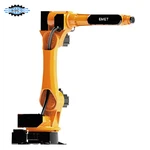


Press Loading And Unloading Robot
The Press Loading and Unloading Robot completely automates the transfer of sheet metal blanks, stamped parts, and formed components into and out of press machinery.
Designed to replace dangerous and repetitive manual handling, the system integrates seamlessly with stamping presses, hydraulic forming presses, automatic feeders, conveyors, inspection stations, and racking systems. Every system is engineered to order-configured around your specific press tonnage, die envelope, workpiece dynamics, and production cycle targets.
Key Technical Specifications
|
Parameter |
Typical Configuration |
|
Number of Axes |
6 |
|
Robot Payload |
10–50 kg* |
|
Maximum Reach |
Approx. 1,400–2,600 mm* |
|
Repeatability |
Typically ±0.05–±0.10 mm* |
|
Mounting |
Floor / Elevated / Customized |
|
Workpiece Handling |
Loading / Unloading / Transfer / Sorting / Stacking |
|
Gripper Type |
Vacuum / Pneumatic / Magnetic / Electric / Combination |
|
Control System |
Robot Controller + PLC |
|
Press Communication |
Digital I/O / Industrial Communication |
|
Workpiece Detection |
Photoelectric / Proximity / Pressure / Vision |
|
Operator Interface |
Touchscreen HMI |
|
Operating Modes |
Manual / Single Cycle / Automatic |
|
Recipe Management |
Available for Multiple Workpieces |
|
Material Supply |
Rack / Pallet / Conveyor / Feeder |
|
Finished-Part Handling |
Rack / Pallet / Conveyor / Inspection Station |
|
Safety Protection |
Safety Fence / Door Interlock / Light Curtain / Safety Scanner |
Core Advantages
Increased Productivity: Continuous operation minimizes unnecessary press dwell times and idle periods.
Enhanced Operator Safety: Removes human operators from high-risk press opening zones and pinch points.
Consistent Quality: Repeatable placement reduces die wear and avoids part misalignments.
Flexibility for Production: Easily reprogrammable for new part numbers and changing manufacturing layouts.
Automated Cell Layout Options
Single Press + Single Robot: Compact cell ideal for standalone stamping, punching, or forming machines.
Robot + Automatic Sheet Feeder: Integrates destacking units or roll feeders for continuous raw material supply.
Multi-Press Tandem Line (Press-to-Press): Multiple robots synchronized along a linear press line for multi-stage stamping.
Robot + Inspection / Vision & Stacking: Integrated turn-key cell with inline dimensional checks, defect sorting, and automated palletizing.
Step-by-Step Press Tending Sequence
Material Supply & Double-Sheet Detection: Blanks are presented via automated feeders or stacks. Dual-sheet sensors ensure only a single blank is picked.
Robot Pick-Up & Grip Verification: The robot moves to the pick position; sensors confirm vacuum pressure or mechanical clamping before movement.
Press Entry & Part Placement: The arm extends into the open press daylight and places the raw blank accurately onto the lower die locators.
Retract & Press Trigger: The robot retracts to a designated clear position and sends a "Robot Clear / Press Start" signal to the press safety PLC.
Press Operation: The press completes its stamping or forming stroke while the robot prepares for the unloading movement.
Unload & Transfer: Upon receiving the "Cycle Complete" signal, the robot enters, grabs the formed part, removes it from the die, and transfers it downstream.
End-of-Arm Tooling & Gripper Options
Vacuum Tooling: Uses adjustable suction cups (silicone or nitrile) with vacuum switches for flat sheet metal components.
Pneumatic Finger Grippers: Mechanical clamps designed for parts with defined flanges, holes, or heavy geometry.
Magnetic Grippers: Permanent or electro-magnetic units ideal for perforated plates or ferromagnetic steel parts.
Hybrid / Quick-Change EOAT: Combines vacuum and mechanical clamping. Can be fitted with automatic tool changers for multi-product lines.
Engineering Customization
Product Changeover: HMI recipe storage allows operators to switch production programs with a single touchscreen command.
Quick-Change Tooling: Manual or automatic tool changers (ATC) enable rapid gripper replacement within minutes during product turnarounds.
Custom Material Storage: Tailored entry/exit racks, indexing conveyors, and shuttle tables matched to plant floor layouts.
FAQ
Hot Tags: press loading and unloading robot, China press loading and unloading robot manufacturers, factory, SCARA Assembly and Inspection Robot
You Might Also Like



Send Inquiry