



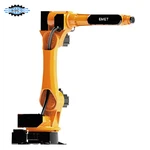


Industrial Palletizing Robot
Automate repetitive palletizing at the end of your packaging line with our high-efficiency 6-axis industrial palletizing robot. Designed to replace manual labor in heavy or hazardous tasks, this robotic cell picks products directly from infeed conveyors and places them onto pallets according to pre-programmed stacking patterns.
Key Specifications
|
Parameter |
Specification |
|
Robot Type |
Industrial Palletizing Robot |
|
Robot Structure |
Articulated Robot |
|
Number of Axes |
6 |
|
Payload |
50–100 kg, depending on model* |
|
Maximum Reach |
Up to 2732 mm* |
|
Repeatability |
±0.08 mm* |
|
Protection Rating |
IP63* |
|
Installation |
Floor Mounted |
|
Operating Temperature |
0–45°C* |
|
Operating Humidity |
20–80%, non-condensing* |
|
Robot Weight |
Approx. 655 kg* |
|
Rated Power |
Approx. 5.0 kVA* |
|
End Effector |
Vacuum, Mechanical or Customized |
|
Pallet Pattern |
Programmable |
|
Conveyor Integration |
Available |
|
Safety System |
Application-dependent |
Key Advantages
Flexible 6-Axis Motion: Enables full 360° product orientation adjustments, providing seamless access to dual pallet stations or complex layer arrangements.
Reduced Labor & Fast ROI: Replaces high-intensity manual labor, reducing downtime, product breakage, and occupational health risks.
Multiple Payload & Reach Options: Adaptable mechanical structures to accommodate heavy industrial sacks, delicate consumer cartons, or high-reach pallet configurations.
Programmable Recipe Management: Switch between multi-SKU palletizing routines quickly via the HMI without stopping production lines.
Complete Turn-Key Cell Integration: Effortlessly pairs with infeed conveyors, pallet dispensers, stretch wrappers, and plant-wide PLC networks.
Typical Applications
Food & Beverage: Dairy, bottled/canned drinks, bakery cases, packaged dry foods.
Building Materials: Cement sacks, tile adhesives, mortar bags, raw chemical compounds.
Agriculture & Grain: Seed bags, fertilizer sacks, packaged animal feeds, grain exports.
Chemicals & Plastics: Resin bags, plastic pelleted containers, drum/pail boxes.
Consumer Goods: Personal care boxes, household cleaning supplies, paper goods.
General Manufacturing: Finished goods, automotive components, hardware cases.
How the Palletizing System Works
Product Infeed: Upstream packaging line delivers products to the designated pick-up station via conveyor.
Product Detection: Integrated sensors or PLC signals trigger precise product arrival and orientation indexing.
Robotic Pick-Up: The 6-axis robot moves to the target point and activates the specialized gripper (vacuum/mechanical).
Product Transfer: The robot dynamically adjusts product angle and path during movement toward the palletting station.
Pallet Placement: Products are placed according to the selected stacking pattern recipe.
Layer Completion: The system automatically shifts height parameters layer-by-layer until the preset stack height is reached.
Full Pallet Outfeed: The completed pallet is dispatched via conveyor to automatic strapping, stretch wrapping, or warehouse staging.
Palletizing Patterns
Column Stacking: Products maintain identical orientation across all layers. Ideal for high vertical compression strength requirements.
Interlocking Stacking: Alternate layers are rotated by 90° or 180° to tie products together, increasing structural stability.
Alternating-Layer Stacking: Unique layer geometries are used on successive tiers to prevent load shifting on smooth or unstable packages.
End-of-Arm Tooling
Vacuum Grippers
Best Suited For: Rigid, non-porous flat surfaces.
Typical Applications: Corrugated cartons, sealed rigid boxes, plastic trays, flat-top consumer packs.
Mechanical Grippers
Best Suited For: Flexible, porous, or irregular packaging where vacuum suction is unreliable.
Typical Applications: Woven bags, paper sacks, porous pouches, open-top crates, irregular bundles.
Customized / Hybrid Tooling
Best Suited For: Complex multi-pick applications or fragile items requiring combined side-clamping, bottom-support, or vacuum assist.
Design Considerations: Product weight/dimensions, packaging permeability, acceleration forces, surface sensitivity, and quick-change couplings.
Customization & System Configuration
Every robotic cell is customized around actual production environments:
Robot Selection: Sized according to total load envelope and kinematic reach requirements.
EOAT Customization: Engineered specifically for your product's structural strength and packaging characteristics.
Software & Pattern Recipes: Multi-SKU loading patterns pre-programmed prior to shipment for simple operator selection.
Layout Optimization: Configured for single-infeed/single-pallet, single-infeed/dual-pallet, or multi-line loading based on floor plan constraints.
Safety Integration: Fully compliant perimeter fences, safety door interlocks, and zone safety sensors configured to local standard protocols.
After-Sales Support
Installation & Commissioning: On-site engineering support available globally, alongside remote guidance via augmented reality (AR) or direct line diagnostic access.
Warranty & Spare Parts: Standard 12 to 24-month warranty on major components, with critical spare parts kits available for rapid dispatch.
Training: Comprehensive operational and maintenance training provided for your local plant engineers.
FAQ
Hot Tags: industrial palletizing robot, China industrial palletizing robot manufacturers, factory, SCARA Industrial Robot
Previous
Automatic Palletizing RobotNext
No InformationYou Might Also Like



Send Inquiry