



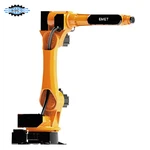


Automatic Palletizing Robot
The Automatic Palletizing Robot automates the transfer and stacking of finished goods at the end of production lines. Designed for heavy-duty industrial environments, it precise picks, positions, rotates, and stacks products onto pallets based on customizable layer patterns.
With 50 kg and 100 kg wrist payload options, a maximum working radius of approx. 2,700 mm, and high repeatability of ±0.08 mm, this system can be tailored to meet your specific throughput, packaging type, and plant layout requirements.
Key System Specifications
|
Specification |
Standard Configuration |
|
Robot Structure |
Articulated Industrial Robot (4-Axis / 6-Axis) |
|
Rated Payload |
50 kg / 100 kg (Total load including gripper & tooling) |
|
Working Radius |
Up to approx. 2,700 mm |
|
Repeatability |
Up to ±0.08 mm |
|
Protection Rating |
IP63 (Dust & Splash Resistant) |
|
Operating Conditions |
Temp: 0–45°C |
|
Drive & Control |
Servo Motor Drive + Dedicated Controller + Integrated PLC |
|
End Effector |
Vacuum / Mechanical / Clamp / Customized Tooling |
|
Safety Compliance |
Complies with ISO 10218, CE, Safety Interlocks & E-Stop |
|
Mounting Type |
Floor-mounted |
Key System Advantages
Higher Throughput & Precision: Reduces bottlenecking at end-of-line packaging with consistent stacking quality.
Ergonomic & Safety Improvement: Eliminates heavy manual lifting and hazardous repetitive labor.
Flexibility: Quick recipe changes via HMI for diverse SKUs and dual-pallet layouts.
Seamless Line Integration: Standard digital I/O and industrial Ethernet interfaces allow effortless handshake with existing PLCs, wrappers, and conveyors.
Industry Applications
Food & Beverage: Cartons, beverage cases, tray-packed cans, and pails.
Chemicals & Agriculture: Fertilizers, feed bags, resin sacks, and plastic drums.
Building Materials: Cement bags, tile boxes, and joint compound containers.
Consumer Goods & Logistics: E-commerce shipping boxes, paper bags, and mixed industrial packaging.
System Components
Industrial Articulated Robot: Core motion unit providing 4-axis or 6-axis articulated movement.
Dedicated Robot Controller & PLC: Manages trajectory planning, safety signals, and I/O communication.
Infeed Product Conveyor: Belt or roller conveyor bringing finished items from upstream sealing/packing lines.
End-of-Arm Tooling: Custom-designed gripper tailored to product specifications.
Product Detection & Positioning Sensors: Photoelectric/vision sensors to signal precise pick location.
Pallet Positioning & Handling System: Mechanical stops, pallet dispensers, and pallet conveyors for empty/full pallet transfer.
HMI Touchscreen: Intuitive user interface for recipe management, operational status, and diagnostics.
Safety Perimeter Enclosure: Physical safety fencing, light curtains, interlocked doors, and E-stop circuits.
How the Automated Palletizing System Works
Infeed & Detection: Products enter from the packaging line via conveyor. Sensors verify position and ready status.
Gripping: The robot picks single or grouped products using tailored end-of-arm tooling.
Transfer & Rotation: The arm moves along an optimized trajectory, rotating the product as dictated by the program.
Precision Placement: Products are stacked according to the pre-programmed grid coordinates.
Layer Completion: The robot completes layers consecutively until the pallet reaches target height.
Pallet Outfeed: Completed pallets move via automated conveyor to stretch wrappers or forklift pickup stations.
Stacking Patterns & Program Flexibility
Standard Pattern: Uniform placement for rigid, identical cartons.
Interlocking / Cross-Layer Pattern: Alternates layer orientations by 90°/180° to lock products together and maximize load stability during transit.
Multi-Recipe Storage: Save dozens of distinct product profiles and stacking layouts in the HMI. Operators can switch production runs in seconds with a simple touch.
Dual-Pallet Configurations: Optional twin-station layouts allow the robot to palletize continuously on one side while the operator clears the completed pallet on the other side.
Customization & Engineering Options
We tailor every cell to your plant environment:
Robot Configuration: 4-axis / 6-axis options, extended reach models.
Pallet Management: Automatic pallet dispensers, slip-sheet placers, and dual-pallet stations.
Control System: Allen-Bradley, Siemens, or Mitsubishi PLC options with multi-language HMI interfaces.
Safety Enclosure: Safety fences, light curtains, interlocked access doors, and safety scanners.
Global After-Sales Service
Remote Diagnostics: Integrated remote-access capabilities for real-time troubleshooting, software updates, and PLC logic adjustments via secure network links.
Commissioning & Training: Comprehensive digital documentation, step-by-step video installation guides, and optional on-site engineering dispatch.
Spare Parts Availability: Standardized industrial parts ensure quick replacement availability worldwide.
FAQ
Hot Tags: automatic palletizing robot, China automatic palletizing robot manufacturers, factory, SCARA Industrial Robot
You Might Also Like


Send Inquiry