



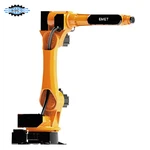


Mechanical Assist Manipulator
A Mechanical Assist Manipulator helps operators lift, move, rotate, tilt, and position industrial workpieces with minimal physical effort. By combining an articulated mechanical arm, precise pneumatic balancing, and a workpiece-specific gripping fixture, the system supports the full load weight while keeping the operator in direct control during repetitive handling tasks.
Technical Specifications
|
Parameter |
Reference Capability Range |
|
Payload Capacity |
15 kg – 500+ kg |
|
Working Radius (Reach) |
Up to 3,500 mm |
|
Vertical Stroke |
1,200 mm – 2,200 mm |
|
Air Supply Pressure |
0.5 – 0.7 MPa |
|
Main Materials |
Structural Steel / High-Strength Aluminum |
|
Rotation Angle |
360° main axis / Up to 180° end-effector |
Typical Applications
CNC Machine Loading & Unloading
Task: Transfer raw castings from pallets into vertical or horizontal machining centers.
Handling Sequence: Pick up → Lift → Reach into enclosure → Precise positioning on fixture → Clamp.
Design Factors: Reach radius, door opening clearance, and chip/coolant resistance.
Automotive & Equipment Assembly
Task: Position heavy components onto moving or stationary chassis lines.
Handling Sequence: Lift → Horizontal transfer → 90° Tilt / Rotate → Micro-alignment → Fasten.
Design Factors: Orientation lockouts, alignment tolerances, and ergonomics.
Production Station Line Transfer
Task: High-frequency relocation of parts between adjacent conveyors or work cells.
Handling Sequence: Lift → Rapid transfer → Controlled drop-off.
Design Factors: Cycle time efficiency, continuous pneumatic flow, and broad motion envelope.
Key Configuration Overview
|
Item |
System Configuration Options |
|
Product Type |
Industrial Mechanical Assist Manipulator |
|
Operating Method |
Manual guidance with pneumatic lifting assistance |
|
Balancing System |
Precision pneumatic counterbalancing |
|
Arm Configuration |
Rigid articulated arm / Cable-driven vertical stroke |
|
Mounting Options |
Floor-mounted column / Overhead suspended / Rail-mounted overhead |
|
End Effector |
Application-specific customized gripping fixture |
|
Main Handling Functions |
3D Space Lifting, Horizontal Movement, Continuous Rotation, Controlled Tilting |
Why Use a Mechanical Assist Manipulator?
Eliminates repeated heavy manual lifting and reduces physical strain.
Improves control and precision during final positioning.
Supports high-frequency transfer operations without operator fatigue.
Keeps the human operator directly involved in complex manipulation tasks.
Core Operating Principle
Grip: The custom end effector engages the workpiece securely using dedicated mechanical, pneumatic, or vacuum clamping mechanisms.
Balance: The pneumatic system applies counter-balancing torque to neutralize the total weight of the load.
Guide: The operator effortlessly guides the part along the target path with minimal physical effort.
Position: The system enables high-precision alignment into machines, jigs, or packaging lines.
Integrated Safety Functions
Air Supply Fail-Safe Protection: Retains pneumatic pressure in the system to prevent load dropping during sudden compressed air supply interruption.
Buffer Reserve Tank: Integrated air receiver tank provides emergency pneumatic power to safely lower the workpiece if air supply fails.
Low-Pressure Warning: Audio/visual safety alerts trigger if system pressure falls below operational thresholds.
Misoperation Interlocks: Prevents accidental release of the workpiece while the load is suspended in mid-air.
Safety Brake System: Mechanical park and motion brakes hold the arms securely when idle or during power faults.
Application Data Required for Quotation
To evaluate your application and provide an accurate technical proposal, please provide the following details:
Workpiece Data: Weight, 2D/3D drawings, material, surface condition, and center of gravity.
Motion Path: Pick-up height, drop-off height, total reach radius, required rotation/tilt angles.
Workstation Layout: Floor space dimensions, ceiling height clearance, existing structures, compressed air availability.
Handling Tasks
CNC Machine Loading and Unloading: Transfer components safely between pallets, workstations, and machine beds with high precision.
Assembly: Support and position repetitive components to eliminate operator fatigue and maintain assembly accuracy.
Production Transfer: Move heavy items smoothly between adjacent manufacturing cells.
Component Rotation: Reorient parts prior to machining, inspection, or packaging.
Maintenance Handling: Assist technicians in lifting and aligning heavy machine components during servicing.
Custom Grippers & End-Effector Integration
The end effector serves as the critical mechanical interface between the manipulator and your workpiece. Standard and custom gripping methods include:
External / Internal Clamping: Pneumatic or mechanical jaws matched to part geometry
Vacuum & Magnetic Lifters: For sheet metal, flat surfaces, or non-porous parts
Hook & Hole Engagement: Dedicated pin expansion or lifting-point fixtures
Powered Rotators & Tilters: Pneumatic actuator-driven 90°/180° rotation and tilting modules
FAQ
Hot Tags: mechanical assist manipulator, China mechanical assist manipulator manufacturers, factory, algorithm controlled manipulator arm, assembled mounted manipulator arm, customizable manipulator arm, fluid sensor guided manipulator arm, maintenance free manipulator arm, servo driven manipulator arm
Previous
No InformationYou Might Also Like


Send Inquiry