



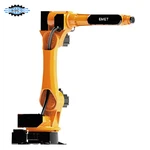

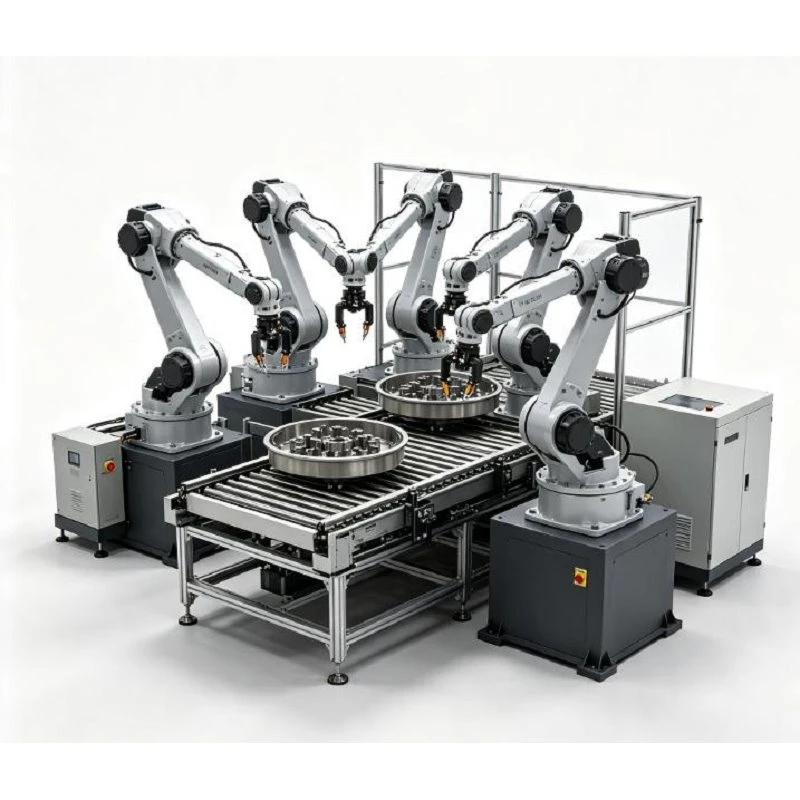
Robotic Loading And Unloading Workstation
The Robotic Loading and Unloading Workstation automates repetitive workpiece transfer between CNC machines and material stations. Designed to replace manual handling, the system keeps CNC machining running continuously under standardized controller signals. Whether retrofitting existing CNC machinery or building new automated production cells, the workstation adapts seamlessly to diverse machine interfaces, workpieces, and facility layouts.
Technical Specifications
|
Specification |
Typical Range / Options |
|
Robot Type |
6-Axis Industrial Robot |
|
Robot Payload |
10–50 kg |
|
Robot Reach |
1,400–2,200 mm |
|
Repeatability |
±0.03–0.08 mm |
|
Workpiece Weight |
5–40 kg |
|
Workpiece Size |
Ø20–300 mm | Length: 30–500 mm |
|
Handling Cycle |
10–40 s |
|
Gripper Type |
Pneumatic / Electric / Customized |
|
CNC Interface |
Digital I/O / Ethernet / Fieldbus |
|
Material Feeding |
Tray / Pallet / Drawer / Bin / Fixture |
|
Auxiliary Options |
Vision / Air Blow-Off / Washing / Inspection / Marking / QR Code / Auto Gripper Change |
Production Benefits
Higher Spindle Utilization: Keeps CNC machines running consistently during operator breaks, shift changes, and unstaffed hours.
Reduced Labor Dependency: Allows one operator to manage multiple automated cells, shifting human labor to high-value tasks like QA, tooling maintenance, and programming.
Consistent Component Quality: Eliminates part seating errors caused by fatigue, ensuring consistent loading repeatability (±0.03 mm).
Flexible Manufacturing: Easily adaptable to new part numbers via programmable paths, quick-change gripper jaws, or automatic tool changers.
Typical Production Applications
CNC Lathes & Turning Centers: Shafts, bushings, sleeves, flanges, discs, automotive turned components.
CNC Machining Centers (Milling): Aluminum/steel housings, engine brackets, hydraulic manifolds, structural blocks.
Hydraulic & Pneumatic Components: Valve bodies, fittings, sleeves, spool housings.
Automotive Sub-assemblies: Wheel hubs, brake components, gear blanks, transmission shafts.
Standard Operational Process Flow
Material Supply: Parts are organized in trays, drawers, or fixtures.
Part Picking: The robot approaches the feeding station and grips the workpiece.
Position Verification: Sensors or vision confirm correct alignment before entering the machine.
CNC Loading: The robot places the raw part into the CNC chuck/fixture.
Machining Cycle: Upon receipt of robot clearance signals, the door closes and machining starts.
Unloading & Transfer: The CNC sends a "Cycle Complete" signal; the robot retrieves the finished part and places it onto the output station or secondary processing unit.
Gripper Tooling & End-of-Arm Tooling
Single Gripper: Ideal for applications where CNC machining cycle time is long enough to allow a two-step unload/load sequence.
Double Gripper (Fast Part-Exchange): Holds a raw part and a finished part simultaneously. Dramatically reduces machine door-open time by swapping parts in a single entry motion.
Customized Jaws: Engineered specifically for part geometry (shafts, rings, prismatic blocks), surface sensitivity, and clamping requirements.
Material Feeding Systems
Fixed Trays & Pallets: Provide high precision and repeatability for high-volume, uniform components.
Drawer Systems: Multi-tier storage maximizing buffer capacity within a compact floor footprint.
Bulk Bins with Vision Guidance: For semi-structured or randomly placed parts requiring automated identification.
Dedicated Custom Fixtures: Tailored positioning for irregular forgings or castings.
Optional Integrated Modules
Vision-Guided Picking: Auto-detects part orientation on flexible feeding lines.
Air Blow-Off & Chip Removal: Cleans chip debris and coolant off parts and fixtures prior to unloading.
In-Line Part Washing: Cleans finished parts before downstream operations.
Automatic Inspection & Gauging: Integrates probing or vision measurement for quality control.
Laser / Dot-Peen Marking: Provides automated traceability coding (QR/Barcodes).
Automatic Tool/Gripper Changer: Enables quick switching between different product runs.
FAQ
Hot Tags: robotic loading and unloading workstation, China robotic loading and unloading workstation manufacturers, factory, SCARA Assembly and Inspection Robot
Previous
No InformationYou Might Also Like




Send Inquiry