



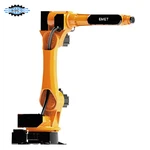


Robotic Palletizing System
The Industrial Welding Robot is a 6-axis articulated robotic system engineered for high-precision, automated MIG, MAG, TIG, and arc welding applications. Featuring a versatile 6-axis kinematic design, the robot arm delivers full pitch, roll, and yaw control of the welding torch. This ensures optimal torch orientation across complex geometries, including corner joints, inclined seams, internal spatial welds, and multi-directional weldments.
Technical Specifications
|
Parameter |
Typical Specification |
|
System Type |
Robotic Palletizing System |
|
Robot Configuration |
4-axis palletizing robot / 6-axis industrial robot |
|
Robot Payload |
Approx. 20–150 kg |
|
Robot Reach |
Approx. 1,600–3,200 mm |
|
Product Weight |
Approx. 1–100 kg/piece |
|
Typical Palletizing Rate |
Approx. 6–20+ picks/min |
|
High-Speed Rate |
Up to approx. 25–36+ picks/min |
|
Common Pallet Sizes |
800 × 1,200 mm / 1,000 × 1,200 mm / 1,100 × 1,100 mm |
|
Typical Pallet Height |
Up to approx. 1,500–2,000 mm including pallet |
|
Product Types |
Cartons, cases, bags, boxes, trays, pails, drums |
|
Pallet Pattern |
Column / Interlocked / Pinwheel / Custom |
|
Product Infeed |
Single lane / Dual lane / Multiple lanes |
|
Pallet Positions |
Single / Dual / Multiple |
|
Gripper |
Vacuum / Clamp / Fork / Mechanical / Customized |
|
Control System |
PLC + Robot Controller + HMI |
|
Product Detection |
Photoelectric / Proximity / Optional Vision |
|
Pallet Detection |
Photoelectric / Proximity |
|
Safety Protection |
Safety fence / Safety door / Light curtain / Area scanner |
|
Operating Mode |
Automatic / Manual / Maintenance |
|
Power Supply |
Typically 380–480 VAC, 3-phase |
|
Pneumatic Supply |
Typically 0.5–0.7 MPa when pneumatic tooling is used |
|
Installation |
Floor-mounted robotic cell |
|
Pallet Changeover |
Manual or automatic |
|
Layout |
Standard or customized |
Key Operational Advantages
Uncompromising Stacking Accuracy: Precise millimeter repeatability eliminates leaning pallets and product damage.
Enhanced Labor Safety & Ergonomics: Removes operators from dangerous, repetitive heavy lifting tasks.
Multi-SKU Rapid Changeover: Select stored pallet recipes instantly via the HMI without physical cell re-engineering.
Continuous Non-Stop Operation: Dual-pallet configurations allow seamless removal of completed pallets without pausing production.
Future-Proof Modular Integration: Easily connects with AGVs, automated guided vehicles, stretch wrappers, and ERP/MES manufacturing networks.
Industry Applications
Food & Beverage: Sealed cases, beverage crates, frozen food cartons, pouch trays, and canned goods.
Chemicals & Petrochemicals: Resin bags, fertilizer sacks, chemical pails, lubricants, and 55-gallon drums.
Agriculture & Animal Feed: Bulk seed sacks, animal feed bags, and agricultural crop boxes.
Building Materials: Mortar bags, tile boxes, paint cans, and hardware packaging.
Consumer Goods & Pharmaceuticals: High-speed carton packaging and multi-size retail shipper cases.
System Architecture
Industrial Robot Arm
4-Axis Palletizing Robots: Ideal for high-speed, standard horizontal carton and case stacking with minimal rotational needs.
6-Axis Industrial Robots: Recommended when complex product orientation, tilt positioning, or tight space maneuvering is required.
Selection Criteria: Payload capacity, reach, cycle time, target pallet height, and total pick positions.
Product Infeed Conveyor System
Transfers incoming items smoothly to the designated robot pick position:
Conveyor Layouts: Single-lane, dual-lane, or multi-lane infeed.
Flow Control: Accumulation zones, product separators, orienting mechanisms, and precise positioning stops.
End-of-Arm Tooling
Engineered based on product weight, packaging strength, surface texture, and cycle speed requirements:
Vacuum Grippers: Foam pads or suction cup arrays with integrated vacuum sensing for corrugated boxes and cartons.
Clamp Grippers: Side-clamping or top-clamping mechanisms for woven bags, sacks, and porous packaging.
Fork / Bottom-Support Grippers: Mechanically supports heavy, flexible, or fragile packages from underneath.
Multi-Pick Tooling: Grips multiple products in a single cycle to double or triple throughput.
Pallet Handling System
Manual Pallet Placement: Cost-effective setup using floor marks or mechanical alignment guides.
Automatic Pallet Dispenser: Stores empty pallets and automatically feeds them into the loading position.
Pallet Discharge Conveyor: Automatically transfers completed pallets out of the cell to stretch wrapping or storage areas.
Integrated Control & Safety
Control Architecture: Main PLC interfaced with the robot controller and a multi-language HMI touchscreen.
Sensor Suite: Photoelectric, proximity, and optional 2D/3D vision sensors for product verification.
Safety Protection: Full perimeter fencing, interlocked access gates, safety light curtains, and emergency stop circuits meeting international industrial safety standards.
How the Palletizing System Works
Product Infeed & Positioning: Products arrive from upstream processes and are singulated or grouped into pick positions.
Verification & Identification: Photoelectric sensors (or vision cameras) confirm product arrival, orientation, and SKU type.
Precision Pick: The end-of-arm tool engages the load. Sensors verify vacuum draw, clamp pressure, or mechanical grip before motion starts.
Optimized Transfer: The robot moves along a calculated collision-free trajectory to the target pallet station.
Pattern Placement & Layer Stacking: Products are placed according to pre-programmed coordinates. The cycle repeats until layer and total stack height requirements are met.
Pallet Discharge: The completed pallet is automatically signaled for conveyor transfer to downstream wrapping or AGV pickup.
Pallet Stacking Patterns
Programmable pattern flexibility ensures maximum load stability for transport and storage.
Column Stacking: Products aligned strictly in vertical columns. Ideal for rigid containers where vertical corner strength is required.
Interlocked Stacking: Layers alternate orientation by 90° or 180°. Creates structural binding to prevent loads from shifting during transit.
Pinwheel Stacking: Products arranged in a spiral lock pattern around the pallet center. Excellent for square or near-square footprints.
Custom / Multi-SKU Stacking: Fully customizable layer recipes programmed via touchscreen interface for non-standard package dimensions.
Customization & Optional Modules
Automatic Slip-Sheet / Tier-Sheet Dispenser: Places protective cardboard or plastic sheets between pallet layers.
Pallet Dispenser Magazine: Automatically feeds empty pallets into the palletizing zone (capacities up to 15 pallets).
Integrated Barcode / Vision Inspection: Verifies SKU labels and package orientation before picking.
Integrated Pallet Weighing & Labeling: Inline scale and automated corner labeling before warehouse entry.
FAQ
Hot Tags: robotic palletizing system, China robotic palletizing system manufacturers, factory, SCARA Industrial Robot
You Might Also Like



Send Inquiry