



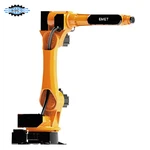


Heavy-Payload Palletizing Robot
The Heavy-Payload Palletizing Robot is an automated end-of-line solution engineered for heavy-duty industrial handling. It automatically picks, moves, and stacks bags, cartons, cases, drums, and heavy containers onto pallets with high repeatability and speed.
Designed for continuous multi-shift operations, the system replaces hazardous manual lifting, improves pallet stack stability, and streamlines packaging line output.
Technical Specifications
|
Technical Parameter |
Engineering Specification |
|
Robot Type |
Industrial Heavy-Payload Palletizing Robot |
|
Axis Configuration |
4-Axis Heavy Palletizing Arm / 6-Axis Articulated |
|
Rated Payload |
100 kg to 300 kg (Tooling + Payload) |
|
Maximum Vertical Reach |
Up to 3,600 mm |
|
Robot Weight |
Approx. 1,100 kg – 1,850 kg |
|
Installation Type |
Floor Mounted (Reinforced Concrete Base) |
|
Operating Temperature |
0 °C to +45 °C |
|
Power Supply / Rating |
380V–415V AC, 3-Phase, 50/60 Hz / 7.5–12 kW |
Key Advantages
Engineered Load Capacity: Structural design accounts for high dynamic forces, load centers, and heavy EOAT masses.
Controlled Heavy-Motion Profiles: Smooth acceleration/deceleration curves prevent product shift or bag rupture during high-speed movement.
High Stacking Precision: ±0.06 mm repeatability ensures perfectly straight pallet stacks, improving warehouse storage efficiency and transport stability.
Versatile Integration: Fully compatible with major industrial PLC systems, fieldbus communications, and end-of-line packaging machinery.
Drastic Labor Risk Reduction: Replaces dangerous, repetitive manual lifting of heavy items, complying with modern occupational safety standards.
Industry Applications
Building Materials & Minerals: Cement bags, dry-mix mortar, tile adhesive, refractory bricks.
Agriculture & Chemicals: Fertilizer bags, animal feed, grain, resin drums, chemical pails.
Food & Beverage Processing: Beverage cases, bulk flour/rice/sugar bags, edible oil containers.
Industrial Manufacturing: Machinery castings, automotive sub-assemblies, heavy carton packaging.
Logistics & Warehousing: High-throughput distribution centers handling mixed heavy packages.
Flexible Cell Layout Configurations
Single Pallet Station: Compact footprint, ideal for low-to-medium line speeds where empty/full pallets are swapped manually or via forklift.
Double Pallet Station (Non-Stop Operation): The robot continues stacking on Station B while an operator or AGV safely unloads Station A.
Multi-Line Centralized Cell: A single long-reach robot services 2–3 incoming conveyors carrying different products simultaneously.
End-of-Arm Tooling Solutions
Vacuum Gripper Systems: Equipped with high-flow blowers or multi-stage ejectors, localized zone controls, and sponge pads for porous surfaces (woven bags, unsealed cartons).
Mechanical Clamps: Gentle yet secure side-pressure clamping for boxes, pails, or non-porous containers.
Fork & Bottom-Support Grippers: Slides under heavy bags or loose bundles to guarantee physical support during high-speed acceleration.
Full-Layer Grippers: Picks an entire pre-arranged product layer in one movement, significantly boosting output while reducing robot speed requirement.
Operational Workflow
Infeed & Accumulation: Products arrive from upstream packaging units via powered conveyors.
Singulation & Orientation: Indexing stoppers align and orient products (turning cartons 90°).
Pick Ready Signal: Sensors confirm product presence at the exact pick coordinates.
Secure Pick: Robot moves to the pick point; gripper engages and verifies grip pressure/vacuum switch status.
Dynamic Trajectory Handling: Robot moves along a smooth vector path to the designated target layer.
Placement & Release: Product is set down gently; layer sheet (if configured) is applied.
Cycle Completion & Outfeed: Once the pallet reaches full layer height, the system signals the main line PLC to trigger full-pallet transfer via outbound conveyor or AGV.
Safety Architecture
Perimeter Safeguarding: Heavy-duty steel safety fencing surrounding the entire working envelope.
Access Control: Interlocked safety doors with trapped-key systems to prevent unintended access.
Optoelectronic Barriers: Safety light curtains with built-in muting functions at pallet entry/exit zones.
Safety Control: Integrated Dual-Channel Safety PLC / Safety Relays with localized E-Stop network.
Installation Requirements
Foundation: Reinforced concrete floor (minimum 200 mm thickness, C25/30 grade recommended).
Utilities: 380–415V AC 3-Phase power supply; clean dry compressed air line (6.0 bar) for pneumatic grippers.
Preventive Maintenance Schedule
Daily: Visual check of pneumatic lines, vacuum filters, gripper wear pads, and interlock integrity.
6-Month / Periodic: Inspection of joint reduction gear backlash, bolt torque verification, cable harness check.
Annual / 5,000 Hours: Gearbox grease replacement according to factory maintenance schedule; full safety system audit.
FAQ
Hot Tags: heavy-payload palletizing robot, China heavy-payload palletizing robot manufacturers, factory, SCARA Industrial Robot
Previous
Bag Palletizing RobotYou Might Also Like




Send Inquiry