



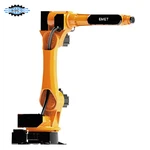


Robotic Palletizing Workstation
The Robotic Palletizing Workstation is an integrated industrial cell engineered to automate the repetitive lifting and stacking of packaged goods. Designed for high reliability and continuous operation, the system seamlessly connects upstream packaging processes to downstream warehousing and logistics, helping global manufacturers reduce labor costs, eliminate bottlenecks, and improve line safety.
Key Specifications
|
Item |
Typical Configuration |
|
Robot Type |
4-Axis / 6-Axis Industrial Robot |
|
Available Robot Payload |
50 kg / 100 kg |
|
Maximum Robot Working Radius |
Up to 2,732 mm |
|
Robot Repeatability |
±0.08 mm |
|
Gripper |
Vacuum / Mechanical / Customized |
|
Product Picking |
Single / Multiple Products |
|
Pallet Pattern |
Column / Brick / Interlocking / Alternating / Custom |
|
Pallet Change |
Manual / Automatic |
|
Control System |
PLC + Robot Controller + HMI |
|
Product Conveyor |
Belt / Roller / Chain |
|
Line Integration |
Packaging / Filling / Bagging / Case Packing / Wrapping |
Key Benefits
Eliminate Repetitive Strain & Labor Shortages: Automates heavy, continuous lifting, significantly lowering workplace injury risks and labor reliance.
Consistent Stack Stability: Programmed positioning guarantees uniform pallet patterns, reducing product damage during transit.
Multi-SKU Flexibility: Store dozens of pre-programmed stacking recipes on the HMI for fast, tool-less product changeovers.
Scalable Output: Easily adjust robot speed and operation logic to keep up with surging seasonal demand.
Compact Footprint: Modular cell layout fits tight floor plans where traditional mechanical palletizers cannot be accommodated.
Suitable Package Types
Cartons & Boxes: Food, beverage, electronics, consumer goods, e-commerce packaging.
Cases & Crates: Bottled products, canned goods, commercial packaging.
Bags & Sacks: Chemicals, powders, agriculture seeds, fertilizer, building materials (cement, mortar).
Pails, Containers & Drums: Paints, lubricants, liquid chemicals, food ingredients.
System Architecture & Components
A fully integrated palletizing cell comprises the following key subsystems:
Industrial Palletizing Robot: Selected based on required payload, reach, and cycle times to pick products from the infeed station and place them accurately on the pallet.
End-of-Arm Tooling (EOAT / Gripper): Engineered specifically for your package type, featuring quick-change interfaces and integrated sensors to verify grip status.
Product Infeed Conveyor: Heavy-duty belt, roller, or chain conveyor equipped with optical sensors for precise product indexing and positioning.
Pallet Positioning & Fixturing: Ensures rigid placement of empty and loaded pallets so the robot can execute repeat placements within sub-millimeter tolerances.
Main Control Cabinet & HMI: Features an intuitive user interface for recipe selection, manual override, error diagnostics, and production tracking.
Comprehensive Safety System: Fully compliant with international industrial safety regulations to guarantee operator protection.
Workstation Operational Sequence
Product Infeed: Packaged goods enter the workstation via the infeed conveyor from upstream production lines.
Detection & Indexing: Optical sensors detect product arrival and lock the package into a precise pick coordinate.
Product Pick: The robot positions the EOAT, verifies secure grip via pneumatic/vacuum pressure switches, and lifts the item.
Transfer & Placement: The robot transfers the payload along an optimized path and deposits it onto the pallet according to the active pattern recipe.
Layer Formation & Layer-Sheet Placement: The process repeats layer by layer. If configured, the robot picks a slip-sheet and places it between layers for added stability.
Pallet Complete Signal: Once the target height is reached, the system flags pallet completion for manual forklift removal or triggers automatic conveyor discharge.
Supported Palletizing Patterns
Column Pattern: Ideal for high compressive-strength packages (e.g., heavy cartons) requiring direct vertical load transfer.
Brick Pattern: Offset rows tie adjacent packages together, enhancing overall stack integrity.
Interlocking Pattern: Orientations rotate 90 degrees between layers, creating a locked structure suitable for taller stacks.
Alternating Layer Pattern: Layer directions flip continuously to distribute weight evenly and prevent tipping.
Custom Programmed Pattern: Custom coordinates designed specifically for mixed-size cartons, irregular cases, or specialized freight requirements.
Engineered Gripper Options
Vacuum Matrix Gripper (Best for cartons, rigid boxes, flat-top cases): Equipped with high-flow vacuum generators, self-sealing foam or suction cups, and integrated blow-off systems for dusty environments.
Mechanical Clamping Tooling (Best for bags, pails, plastic containers, crates): Features soft-touch regulated pneumatic jaws, bottom support fingers, and anti-drop safety latches.
Multi-Pick Tooling (Best for high-speed, multi-pack lines): Picks multiple products per cycle to multiply system output without over-speeding the robot.
Custom / Hybrid EOAT (Best for irregular shapes, combined product + pallet handling): Combined mechanical clamp and vacuum suction for handling products and slip-sheets with a single tool.
Preventive Maintenance Strategy
Simple routine upkeep ensures maximum system uptime:
Daily / Weekly: Clean sensors, inspect pneumatic fittings/vacuum cups, clear debris from conveyors.
Monthly: Check gripper mechanical alignment, verify safety circuit operation, inspect cables and flex-conduits.
Annual: Perform factory-recommended robot axis lubrication, execute full system backup, and recalibrate reference origin points.
FAQ
Hot Tags: robotic palletizing workstation, China robotic palletizing workstation manufacturers, factory, SCARA Industrial Robot
You Might Also Like


Send Inquiry